If you’re researching FADGI because a grant program, a preservation policy, or a vendor’s marketing page mentioned it, there’s one thing worth getting right before anything else: the FADGI star ratings do not apply to motion-picture film. Not at 4-Star, not at any star. The star system belongs to FADGI’s Still Image guidelines — photographs, documents, slides, negatives. FADGI’s publication on motion-picture film is a separate document, and it is deliberately exploratory and non-prescriptive. It defines no compliance levels at all.
That distinction matters because some film-digitization vendors advertise “FADGI-compliant” or “FADGI 4-star” film scans. Whatever the intent, the claim misapplies the standard — and for an archivist, grant writer, or collection manager evaluating vendors, it’s worth understanding exactly why, and what to ask instead.
This guide covers what FADGI actually is, where the star system does and doesn’t apply, and how to evaluate film-scanning vendors on the criteria that genuinely determine quality.
What FADGI actually is
The Federal Agencies Digital Guidelines Initiative is a collaborative working group established in 2007 by US federal agencies engaged in cultural-heritage digitization — the National Archives, the Library of Congress, the Smithsonian Institution, the National Library of Medicine, and others. Its publications live at digitizationguidelines.gov and are freely available. Procurement officers, grant reviewers, and preservation committees across the cultural-heritage sector reference them constantly.
FADGI is a framework, not a regulation. Nothing in it is legally binding outside a specific grant or contract condition. Its value is that it gives a Library of Congress preservation officer and a regional historical society’s collection manager a shared technical vocabulary — when both say “preservation-grade,” FADGI is what lets them mean the same thing.
But FADGI is not one document, and that’s where the confusion starts.
The star system belongs to still images
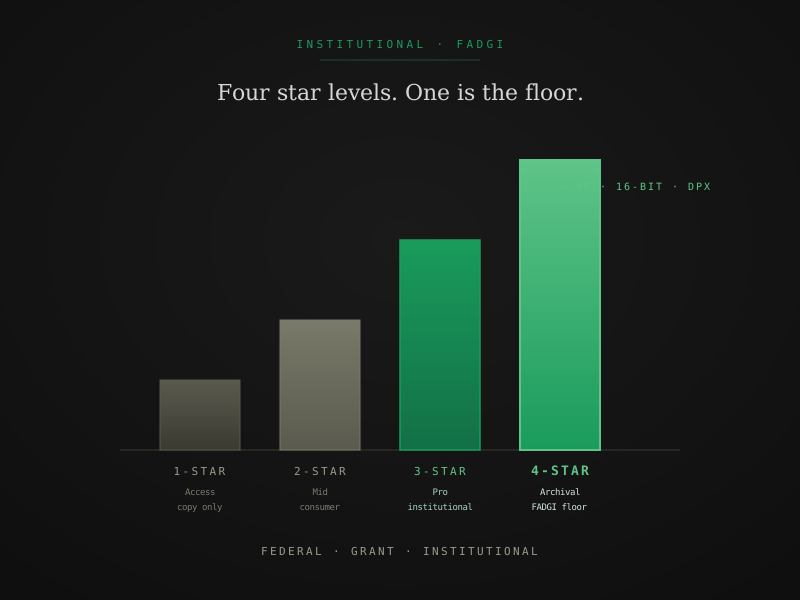
FADGI’s best-known publication is the Technical Guidelines for Digitizing Cultural Heritage Materials — the Still Image guidelines. This is where the 1-Star through 4-Star performance levels are defined, with concrete specifications per material type for resolution, bit depth, color accuracy, tone response, noise, and file format. For still images the star levels are real, measurable, and auditable:
- 3-Star is the common preservation minimum — the level NARA and most institutional policies treat as the floor for preservation work.
- 4-Star is best practice — the highest performance level the framework defines.
If you are digitizing photographic prints, negatives, transparencies, slides, or documents, the star vocabulary applies exactly as advertised. A vendor can legitimately claim, measure, and document a star level for that work, and you can hold them to it.
Film is a different document — and a very different kind of document.
The motion-picture document is exploratory by design
FADGI’s work on motion-picture film is published separately from the Still Image guidelines, and FADGI itself frames it as exploratory: a survey of current practice and open questions in film digitization, not a prescriptive specification. It discusses scanning approaches, resolution considerations, file formats, and workflow issues — but it deliberately stops short of defining performance levels, conformance tests, or star ratings for film.
That restraint is reasonable. Motion-picture digitization involves variables still-image work doesn’t — gauge differences from 8mm to 35mm, shrinkage and warp, optical and magnetic sound, frame-rate handling, the relationship between sensor resolution and the actual detail a small film frame holds. The field hasn’t converged on a single measurable conformance standard the way still imaging has, and FADGI chose to document the landscape rather than legislate it prematurely.
The practical consequence is simple: there is no such thing as a “FADGI 4-star film scan,” because the document that would define one says no such level exists. A film vendor can follow FADGI’s motion-picture guidance — and should — but cannot comply with a rating that was never written.
What it means when a vendor claims it anyway
A vendor advertising “FADGI 4-star film scanning” is borrowing the credibility of the still-image star system and applying it to material the system doesn’t cover. Sometimes that’s an honest mix-up by a marketing department; sometimes it’s deliberate spec-borrowing. Either way, it tells you something useful: the vendor either doesn’t know the standard they’re citing or is counting on you not to. In a field where resolution and capability claims are routinely inflated, that’s a screening signal worth taking seriously.
The better approach is to evaluate film vendors on the parameters that actually determine scan quality. Ask these questions, in writing:
- What transport does the scanner use? Sprocketless, tension-controlled transport is the archival baseline — sprocket-driven and projector-based rigs put stress on exactly the film that can least afford it. (What is sprocketless film transport? covers this in depth.)
- What native resolution, relative to the gauge? “4K” means little without knowing whether it’s a native scan or an upscale, and how it relates to what the gauge actually resolves — an 8mm frame holds roughly 3.3K of real picture detail no matter what the sensor is. A vendor who explains this honestly is worth more than one quoting a bigger number. (2K vs 4K film scanning walks through the per-gauge reality.)
- What bit depth is captured, and is it preserved to the master? 10-bit is the working minimum for a preservation master; higher is better. Ask whether the delivered file keeps it.
- What master formats are delivered? DPX or TIFF image sequences are the institutional preservation standard; a ProRes 4444 master is a strong editorial intermediate. A vendor whose top deliverable is a compressed MP4 is not doing preservation work, whatever the label. (Film scan output formats covers the format landscape.)
- Is condition documented before and after? A written condition report — shrinkage, vinegar syndrome, splices, damage — with your approval before chargeable work is the operational backbone of accountable handling.
- Are checksums provided? A SHA-256 manifest for every delivered file is how fixity gets verified for the life of the asset. It costs the vendor almost nothing and tells you they understand archival delivery.
A vendor who answers all six concretely is doing the work FADGI’s motion-picture guidance describes, whether or not they use the acronym. A vendor who answers with a star rating is doing marketing.
Where the stars do apply — and how FPL uses them
The distinction cuts both ways, and it’s worth being precise rather than dismissive. FADGI’s star levels are genuinely valuable for the material they cover. When FPL digitizes photographs, slides, negatives, and documents, the Still Image guidelines apply in full, and star-level language is the correct vocabulary for that work — 3-Star as the preservation minimum, 4-Star as best practice.
For film, FPL’s practice is FADGI-informed: we follow the approaches the motion-picture guidance discusses, and we document everything so the work can be evaluated against any institution’s own requirements. Concretely, at the Archival tier that means:
- Frame-by-frame scanning on sprocketless, tension-controlled archival transports, with HDR capture and gate options suited to warped and damaged film
- Native scan resolution matched honestly to the gauge — with the overscan-versus-image-area arithmetic explained, not hidden
- High bit-depth capture carried through to the master
- DPX or TIFF sequence preservation masters plus a ProRes 4444 master, with H.264 access copies
- Optical and magnetic sound captured with the image
- A written condition report at intake and a documented chain of custody through delivery
- SHA-256 checksum manifests for every deliverable
None of that is a star rating, because no star rating for film exists. All of it is documented, which is what actually lets an archivist, a grant reviewer, or a procurement officer verify the work.
A note for grant writers
If a grant application’s technical section needs to address standards, the accurate framing for film is direct: state that digitization will follow FADGI’s motion-picture-film guidance (noting that the guidance is non-prescriptive), then specify the concrete parameters — capture method, native resolution per gauge, bit depth, master formats, metadata schema, chain of custody, checksums. For any still-image components of the same project, cite the Still Image guidelines and a specific star level, because there the citation is real.
Reviewers read a lot of boilerplate. A technical section that demonstrates it knows which FADGI document covers which material is rarer than it should be, and it reads as exactly what it is — a project team that understands the standards it’s citing.
For RFP support, structured procurement, and institutional workflow details, see the institutional services page. Per-tier deliverable specifications are on the output formats reference.
If you’d like to discuss a collection, request a pilot scan, or have a draft technical section sanity-checked against the actual guidelines, write to hello@filmpreservationlab.com with a brief description of the material and the grant program. Replies within one business day.
Quick answers from the bench
- FADGI is a guideline framework, not a regulation. Federal grant programs (IMLS, NEH, NHPRC) and institutional digitization policies frequently reference it, but compliance isn't legally mandated outside specific grant or contract conditions. For still images, the star levels give reviewers a concrete benchmark. For motion-picture film, FADGI's own document is exploratory and defines no compliance levels — so a film spec should describe the actual technical parameters rather than cite a star rating.