If you’ve inherited a box of old reels, discovered film in an attic, or pulled a canister out of a relative’s estate, the first question is always the same: what format is this?
The answer matters. Different formats have different scanning requirements, different costs, and different typical use cases. Super 8 and 8mm look almost identical to the untrained eye but are physically different. 16mm might be a family reel or a documentary original. 35mm might be a home movie, a cinema print, or an institutional archive.
This guide walks through identification the way we’d do it at intake — starting with the fastest test (measure the width) and working through the subtler details (sprocket patterns, audio tracks, edge prints) that distinguish the format variants. No special tools required beyond a ruler and good light.
Quick decision flowchart
If you only need the answer and don’t care about the details, work through these four questions in order. Most people find their format in under 30 seconds.
- Is the film wider than your thumbnail (~1 inch / 25mm)? → 35mm
- Is it about the width of a pencil (~16mm / 5/8 inch)? → 16mm
- Is it narrow (~8mm / 5/16 inch) with large, rectangular sprocket holes? → Super 8
- Is it narrow (~8mm / 5/16 inch) with smaller, square sprocket holes on both edges? → Standard 8mm
If you worked through all four and none matched — the width was unusual, or you saw only one row of sprocket holes on narrow film — skip to Section 09 at the end. There are a few less-common formats we don’t scan but can identify.
How to measure film width
The single most reliable identification method is measuring the film width with a ruler. Format names correspond directly to the physical width of the film in millimeters — 8mm film is 8mm wide, 16mm film is 16mm wide, 35mm film is 35mm wide. The only ambiguity is between Super 8 and regular 8mm, which are both 8mm wide but have different sprocket patterns.
The measurement, step by step:
- Carefully unspool about 2 inches of film from the outer edge of the reel. Don’t pull hard — brittle film can snap. If the film is tightly wound and resists gentle unspooling, leave it be and use visual comparison instead.
- Place the film flat on a light-colored surface so you can see the edges clearly.
- Measure the full width across, edge to edge, with a ruler marked in millimeters. If you only have an inch ruler, convert: 1/4 inch ≈ 6mm, 5/16 inch ≈ 8mm, 5/8 inch ≈ 16mm, 1 3/8 inch ≈ 35mm.
- Compare against the reference below. The difference between formats is obvious — nothing is “close” to multiple formats.
Super 8
Super 8 is the most common home-movie format of the 1965 — 1990 era. Introduced by Kodak in 1965 as an upgrade to regular 8mm, Super 8 offered a larger image area on the same 8mm-wide film by using smaller sprocket holes. Most family home movies from the late 1960s onward are Super 8, typically on 3-inch diameter plastic reels running 50 feet.
Quick spec sheet — Super 8 (1965–present):
- Film width — 8mm
- Sprocket holes — One edge only, rectangular (wider than tall)
- Era — 1965 to present, most common 1965 — 1985
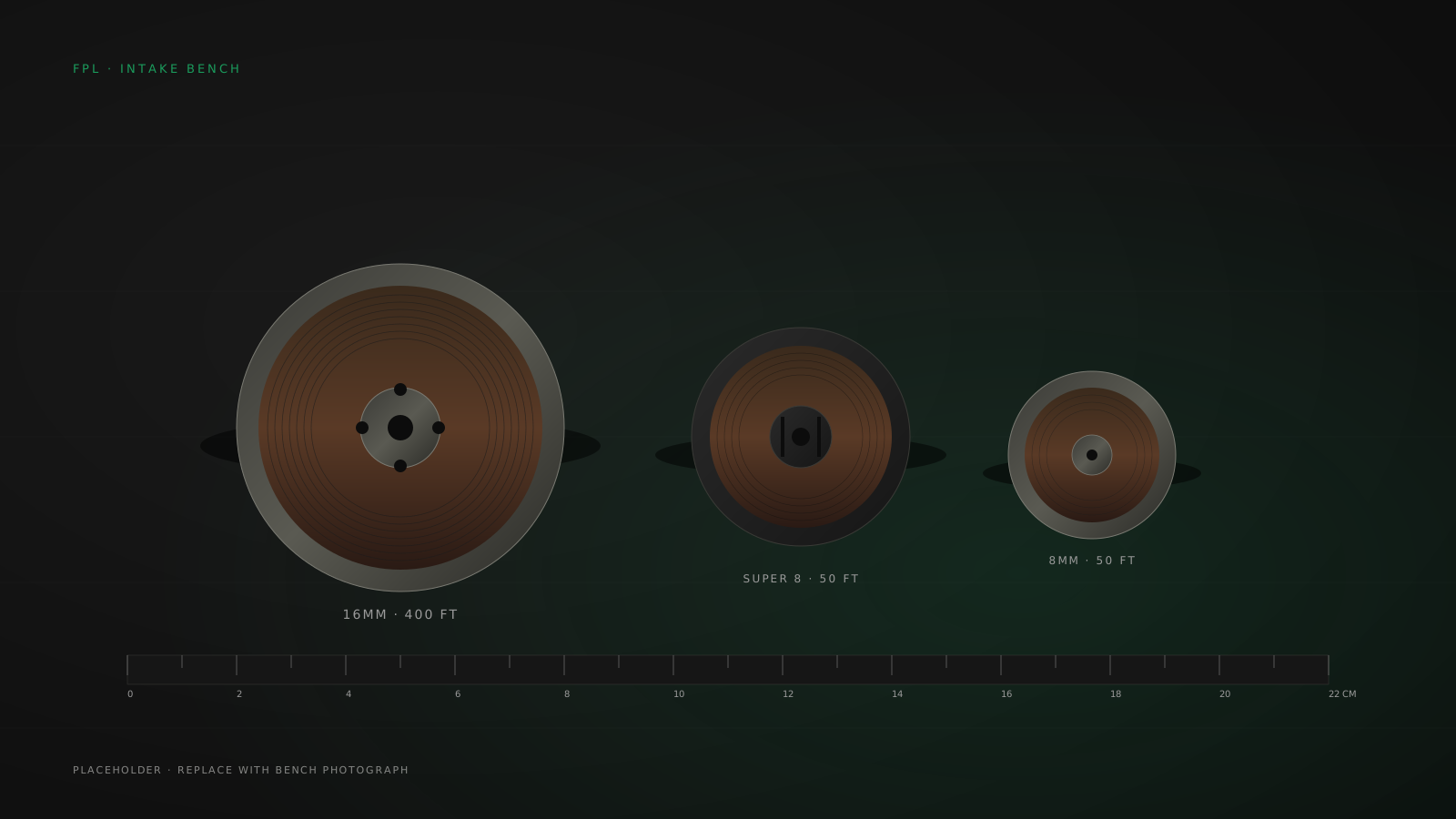
- Reel size — Usually 3-inch plastic, 50 ft
- Runtime — ~3:20 per 50 ft at 18 fps (silent)
- Image area — Larger than 8mm; better resolution
Telltale sign: sprocket holes on Super 8 are noticeably rectangular — wider than they are tall. They’re also larger relative to the film width than on regular 8mm. If you look down the edge of the film and see clearly rectangular cutouts spaced evenly, it’s Super 8.
Cartridges: Super 8 was sold in plastic cartridges (Kodak called them “film magazines”) that snapped into the camera. If you find unopened cartridges rather than reels, they’re almost certainly Super 8 — regular 8mm never shipped in cartridges.
For a deeper format-by-format walkthrough including pricing and tier recommendations, see the Super 8 service page.
Standard 8mm
Regular 8mm — also called Standard 8 or Double 8 — was the dominant home-movie format from 1932 until Super 8 replaced it in the mid-1960s. It’s the same 8mm width as Super 8 but uses smaller sprocket holes, which leaves room for sprockets on both edges of the film (a legacy of how it was manufactured — shot as 16mm film that was then slit in half after processing).
Quick spec sheet — Standard 8mm (1932 — 1970s):
- Film width — 8mm (same as Super 8)
- Sprocket holes — Both edges, square and smaller
- Era — 1932 to ~1970s; dominant through mid-’60s
- Reel size — 3-inch metal or plastic, 50 ft
- Runtime — ~4 min per 50 ft at 16 fps
- Image area — Smaller than Super 8 (more edge used by sprockets)
Telltale sign: sprocket holes appear on both top and bottom edges when you look down the length of the film. They’re square (equally tall and wide) rather than rectangular, and smaller relative to the film width than Super 8 sprockets.
Age cue: if the reels are metal rather than plastic, or if the filmed content appears to be from the 1940s or 1950s, regular 8mm is far more likely than Super 8. Regular 8mm also commonly shipped on single reels without cartridges.
The 8mm service page covers both formats since most family collections mix them.
Super 8 vs Standard 8mm — the tricky comparison
Super 8 and regular 8mm are the hardest to tell apart because they’re the same physical width. The difference is in the sprocket holes — their size, shape, and placement.
The four differences that matter:
- Super 8 sprockets — One edge only. Rectangular (wider than tall). Fewer per inch but larger.
- Standard 8mm sprockets — Both edges. Square (equal height and width). Smaller and more frequent.
- Super 8 image area — Larger; the single sprocket edge leaves more room. ~50% more area than 8mm.
- Standard 8mm image area — Smaller; sprockets on both edges eat into usable image real estate.
Sprockets on both edges of 8mm-wide film means Standard 8mm. Sprockets on one edge means Super 8. That single check resolves about 95% of the “is this Super 8 or 8mm?” questions we get.
16mm
16mm is twice the width of 8mm and was used across a much wider range of purposes — high-end home movies, documentary production, educational film, television news, corporate training, and independent cinema. It was introduced in 1923 as an amateur alternative to 35mm but became the professional workhorse for non-cinema applications.
If you have 16mm film, pay attention to the sprocket pattern — it tells you whether the film is silent or has sound, which changes the workflow and pricing.
Quick spec sheet — 16mm (1923 — present):
- Film width — 16mm (~5/8 inch)
- Silent film — Sprocket holes on both edges
- Sound film — Sprocket holes on one edge only; audio on the other
- Era — 1923 to present; still used for indie film
- Reel sizes — 50, 100, 200, 400 ft (standard), 800, 1,200, 2,000 ft
- Common use — Documentary, educational, corporate, indie film
Tell silent from sound: look at the edges. Both edges with sprocket holes = silent. One edge with sprocket holes + the other edge with a waveform pattern or colored stripe = sound.
Reel size matters: 16mm reels vary enormously. A 50-foot reel runs just over a minute; a 2,000-foot reel runs nearly an hour. If you’re estimating project cost, measure or note reel diameters — the assumption of “10 reels” means very different things for 16mm than for Super 8.
The 16mm service page has the full audio capture story (optical vs magnetic) and tier-by-tier output spec. Inside the lab walks through how 16mm moves through every phase from intake to delivery.
35mm
35mm is the cinema standard — the format that established motion picture as a medium. For most people, 35mm in a home collection means one of three things: a cinema print, a news or archive reel, or (less commonly) a home movie from a family wealthy enough to shoot 35mm in the amateur era.
Quick spec sheet — 35mm (1892 — present):
- Film width — 35mm (~1 3/8 inch)
- Sprocket holes — Both edges, 4 holes per frame
- Era — 1892 to present; still used for cinema
- Reel sizes — 1,000 ft (standard), 2,000 ft, 400/600 ft short ends
- Base type — Safety (post-1952) or nitrate (pre-1952) — see warning
- Common use — Cinema, newsreel, archive, institutional
Reel appearance: 35mm reels are substantially larger and heavier than 16mm. A full 35mm 1,000-foot reel is 10 — 12 inches in diameter and weighs 2 — 3 pounds. If you have small reels (3-inch to 7-inch), it’s almost certainly not 35mm.
Edge print check: 35mm film has manufacturer markings along the edge. Look for the word “SAFETY” or “SAFETY FILM” — that tells you the film base is acetate or polyester, which we can scan. If it reads “NITRATE” or has no safety marking and is pre-1952, see the warning below.
Sound vs silent
Once you know the format, the next useful question is whether it has sound. This affects scanning cost (+$0.12/ft on 16mm and Super 8 sound at Access and Preservation tiers; included at Archival) and determines whether you’ll receive a video or video-plus-audio file.
How to tell by format:
- Super 8 — magnetic stripe. Super 8 sound film has a narrow rust or brown colored stripe running along one edge, opposite the sprocket holes. The stripe is magnetic tape bonded to the film. Silent Super 8 has no stripe — just clear film edges.
- Standard 8mm — almost always silent. Standard 8mm sound film exists but is extremely rare. If your 8mm predates Super 8 (pre-1965), it’s effectively certain to be silent.
- 16mm — optical or magnetic. Silent 16mm has sprocket holes on both edges. Sound 16mm has sprockets on one edge only — the other edge carries either an optical track (printed waveform pattern) or a magnetic stripe (solid brown or brass-colored band).
- 35mm — optical (usually). 35mm sound is optical in most cases — a printed waveform alongside the image. Silent 35mm has full-width image with sprockets on both edges; sound 35mm has a narrower image to make room for the soundtrack.
For the full audio capture story per format — including how we handle warped magnetic stripe, faded optical tracks, and out-of-sync transfers — see the 16mm service page or Inside the lab.
Still can't tell?
A few formats don’t fit the four most common categories. If your measurements don’t match 8mm, 16mm, or 35mm, you may have one of these:
- 9.5mm — Pathé-Baby format from 1922. Central sprocket holes between frames (not on edges). Rare in U.S. collections but common in European ones.
- 17.5mm — Early amateur format, essentially 35mm slit in half. Very rare.
- 28mm — Pathé KOK format, safety-film equivalent of early 35mm. Used by schools and churches in the 1910s — 1920s.
- 65mm / 70mm — Large-format cinema film, about twice the width of 35mm. Used for high-budget productions.
We don’t scan any of these formats ourselves, but we can help identify them and refer you to specialists. For 9.5mm and 28mm, the Center for Home Movies can point you toward qualified facilities. For 65mm/70mm, Colorlab and FotoKem are the established commercial options. The what we transfer page has the full referral list.
Quick answers from the bench
- Look at the sprocket holes. Super 8 has sprocket holes on one edge only and the holes are rectangular (wider than tall). Standard 8mm has smaller square sprocket holes on both edges. Once you've measured the width to confirm 8mm, sprocket pattern is the only test you need.