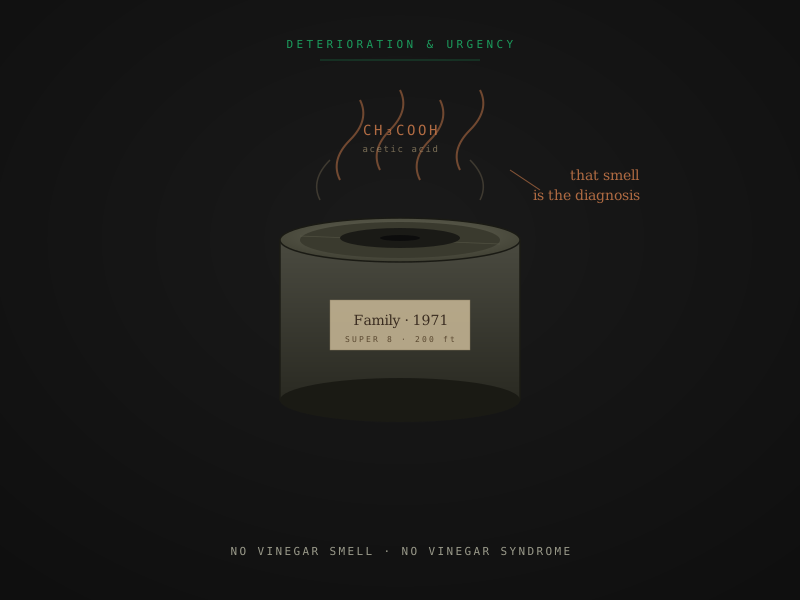
There is a moment when you open a film can — usually for the first time in decades — and a sharp, acidic smell hits your nose. It’s familiar but out of place. White vinegar. Coming from a film can.
That smell is the most reliable diagnostic test for the most common type of film deterioration. This is a short guide to what it means, what stage it indicates, and what to do next.
What you’re smelling
The compound producing the smell is acetic acid: CH₃COOH. It’s the same compound that gives white vinegar its sharp odor, and it’s chemically identical — what your nose detects from a deteriorating film reel is the same molecule, in the same concentration range, doing the same thing.
The acid is being released by the film itself. Cellulose triacetate — the plastic base of nearly all home-movie film made between roughly 1948 and the mid-1990s — breaks down chemically over time, splitting into cellulose and acetic acid. The cellulose stays put; the acetic acid evaporates as a gas. That gas is what reaches your nose when you open the can.
The chemistry is called acetate hydrolysis, and the symptom is called vinegar syndrome. The two names refer to the same process.
The smell is the diagnosis
There’s no other test you need to run for early-stage detection. No equipment, no chemicals, no expertise. Open the can in a well-ventilated room, hold your nose about six inches from the film, and breathe normally. If you smell vinegar, the reel has some stage of vinegar syndrome. If you don’t, it doesn’t.
This works because acetic acid is distinctive in a way few other compounds are. The smell isn’t mistakable for dust, mold, paper, or storage staleness. It’s sharp, cutting, and unmistakable once you’ve experienced it. The first time most people smell vinegar syndrome, the immediate reaction is that smells exactly like vinegar — because it is.
What the intensity tells you
The strength of the smell scales roughly with the stage of deterioration:
Stage 1 — faint. You have to bring your nose close to the can to notice anything. You might wonder if you imagined it. The reaction is just beginning; image quality is unaffected.
Stage 2 — noticeable. Clearly present as soon as you open the can. Similar to opening a fresh bottle of vinegar from a few inches away. Visible warping is starting; color may be shifting.
Stage 3 — strong. Fills the room within seconds. Makes you step back. The reel is visibly cupped or warped; the film may feel tacky or uneven to the touch. Image is recoverable but won’t be perfect.
Stage 4 — overpowering. Affects you from several feet away, sometimes even with the can closed. The film is brittle, severely shrunken, and may have crystals or surface deposits visible. Image recovery is possible but partial; specialist scanning is needed.
Stage 5 — severe. Strong smell from a closed storage container. Film is often fused to itself or the can. The image may not be recoverable through conventional scanning.
You don’t need to know the stage with precision to decide what to do. Stage 1 is faint, stage 5 is overpowering, and the gradations between them are roughly continuous. The thresholds that matter are: faint smell means active decay (start planning digitization), strong smell means advanced decay (digitize this year), overpowering smell means specialist help may be needed.
For the full stage-by-stage breakdown with photos and recoverability notes, vinegar syndrome — the complete guide is the longer piece.
Why this matters more than you’d expect
Two practical implications of the smell that often surprise people:
Vinegar syndrome is contagious
The acetic acid vapor doesn’t just stay on the reel that’s producing it. It accelerates decay in nearby clean film through air contact. A stage-1 reel sealed in a storage box with a dozen healthy reels can pull the entire box toward stage 1 within a few years. The mechanism is the same chemistry happening on every reel, but the existing acid acts as a catalyst that speeds up the reaction in the unaffected film.
If you have one reel with a faint vinegar smell, the move is to separate it from the others immediately. Put it in its own bag or its own can in a different storage location. This single change can buy the rest of the collection years of additional life.
The smell is autocatalytic
Vinegar syndrome accelerates over time. The acetic acid produced by the reaction catalyzes more of the same reaction — chemistry calls this autocatalytic, and it means the deterioration curve isn’t linear. A reel at stage 1 today is more likely to be at stage 2 in three years than at stage 1.5. Once the smell is detectable, the clock is running faster than the previous decades of stable storage suggested.
This isn’t a reason to panic — stages 1 through 3 are still fully recoverable through sprocketless scanning, and a faint-smell reel today has years before it reaches the unrecoverable stages. But it is a reason to stop deferring the digitization conversation indefinitely. The reels won’t wait forever once the smell is there.
For the broader urgency framing across all film deterioration types, film deterioration — what’s happening to your film right now covers the rest of the picture.
What to do when you smell it
Three immediate, no-cost steps for any reel showing a vinegar smell:
- Separate the affected reel from healthy reels in your storage. A different bag, can, or box. Vapor contact is what spreads the chemistry.
- Move the storage out of garages, attics, and basements if it’s currently there. Climate-controlled interior space — even a hall closet at room temperature and reasonable humidity — slows the reaction by 3 to 5 times compared to extreme storage conditions.
- Plan for digitization within the year. Stage 1 reels can wait six to twelve months without significant degradation if storage is stable. Stage 2 and 3 reels benefit from faster action, ideally within six months.
Sprocketless scanning recovers essentially all of the image on stage 1 through 3 reels. The smell doesn’t affect scanability for those stages — the chemistry is doing its damage at the molecular level, not at the surface. A stage-2 reel that smells noticeably of vinegar can still produce an excellent digital scan as long as it’s captured before reaching stage 4.
For the broader inherited-collection framing — what to do when the box you found has a few smelly reels mixed in with the rest — you inherited a box of film, now what is the longer guide.
When to escalate
Some smells warrant attention beyond “plan for digitization soon”:
- Overpowering smell with closed cans suggests stage 4 or 5. These reels benefit from specialist assessment before scanning. Photograph the reels and send the photos with your inquiry.
- Smell combined with visible crystals or surface deposits on the film suggests advanced deterioration that may require solvent rehydration before scanning becomes possible.
- Smell combined with the film being stuck to itself or to the can suggests the reel has fused. Specialist intervention is needed; don’t try to separate it manually.
For these cases, a labs like TMTV in Nelson, BC, or the Library of Congress Packard Campus may be the appropriate next step rather than a general-purpose scanning vendor. We’re happy to advise on routing — reply to any FPL email or write to hello@filmpreservationlab.com with photos and we’ll tell you honestly whether the reel fits our pipeline or warrants a referral.
The shortest version
If you remember three things:
- The smell is acetic acid. The same compound as white vinegar, produced by the chemical breakdown of acetate film base.
- Smell strength scales with stage. Faint at stage 1, overpowering at stage 4 to 5. Stages 1 through 3 are recoverable with sprocketless scanning.
- Separate affected reels immediately. Vinegar syndrome spreads through air contact. The single highest-leverage thing you can do today, at zero cost, is move the smelly reels into their own storage container.
If you have a few smelly reels and a lot of clean ones, the rest of the collection thanks you for the separation. If you’re ready to digitize the affected reels, we’re here when you are.
Quick answers from the bench
- Faint at stage 1 — you have to bring your nose close to the can to notice it, and you might wonder if you imagined it. Noticeable at stage 2 — clearly there as soon as you open the can, similar to having opened a fresh bottle of vinegar. Strong at stage 3 — fills the room within seconds of opening, the kind of sharp scent that makes you step back. Overpowering at stage 4 to 5 — affects you from a few feet away even with the can closed, and lingers in the storage container for days after you remove the reel.