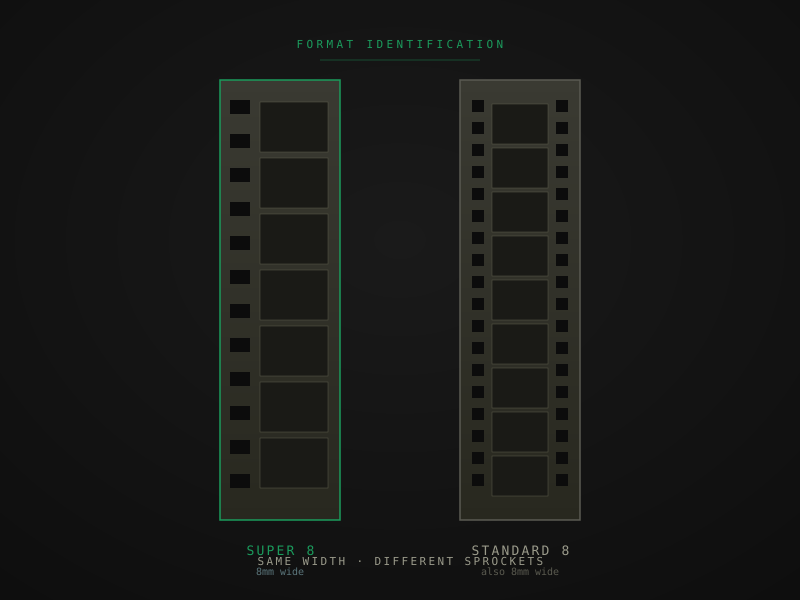
If you've inherited a box of small home-movie reels and someone has casually told you they're “8mm,” you may actually have one of two formats. Both are 8mm wide, both fit small home-movie reels, and they were sold side-by-side at the same drugstore counter for the better part of fifteen years. They aren't the same thing.
This is a guide to telling them apart in under a minute, with a ruler optional and the rest of the family closet untouched.
The one-sentence answer
Super 8 has rectangular sprocket holes on one edge only. Standard 8mm has smaller square sprocket holes on both edges. That's the entire test.
The two formats, briefly
Standard 8mm — sometimes called Regular 8, 8mm cine, or just “8mm” — was Eastman Kodak’s home-movie format from 1932 onward. It used a clever trick: a 16mm-wide film stock was loaded into a camera, exposed on one half running through, then flipped and exposed on the other half running back. After processing, the lab slit it down the middle, producing two 8mm-wide strips spliced end to end. That history matters for one reason — it’s why Standard 8mm has sprocket holes on both edges. The film was originally 16mm.
Super 8 arrived in 1965, also from Kodak, also for home movies, also 8mm wide. The change was the cartridge: instead of threading film through a camera, you dropped in a plastic cartridge. To make that work mechanically, Kodak shrunk the sprocket holes and put them on one edge only. The freed-up space went to a larger image area — roughly 50% more frame space than Standard 8mm.
Both formats kept selling for decades. Super 8 outlived Standard 8mm by a wide margin and is technically still in production today; Standard 8mm faded out by the mid-1970s.
The visible test, in three checks
You don’t need a ruler if you trust your eyes. Hold a section of film up to a light source and look at the edges:
Check 1 — Count the sprocket edges
- One edge only → Super 8
- Both edges → Standard 8mm
That’s the entire test. If you stop here, you’ll be right essentially every time. The remaining checks are confirmations.
Check 2 — Look at the sprocket shape
- Rectangular, wider than tall → Super 8
- Square, small → Standard 8mm
Super 8’s sprocket holes are roughly twice the area of Standard 8mm’s. Side-by-side, the difference is unmistakable.
Check 3 — Look at the image area
- Bigger frame, takes up more of the strip → Super 8
- Smaller frame, more film around it → Standard 8mm
This is the visible payoff of Super 8’s smaller sprocket holes. The image area is bigger, the borders around the image are narrower. Once you know to look for it, the Super 8 frame looks noticeably more “filled in.”
What about the cans and reels?
Sometimes the can or reel itself tells you. Look for printed text:
- “Super 8” — obvious, but only present on commercial pre-recorded reels and some Kodak processing returns
- “8mm” alone, with no “Super” — usually but not always Standard 8mm
- “Regular 8” or “Std. 8” — Standard 8mm, definitively
Don’t trust the label alone. Cans get reused. Reels get swapped. The film inside is the only authoritative answer, and the sprocket pattern is the only authoritative test on the film.
Why the difference matters for digitization
Most consumer customers don’t need to distinguish them — they just want their home movies digitized, and we sort it all out at intake. But two practical points are worth knowing before you ship:
Image quality you’ll see in the scan
Super 8’s larger image area shows up directly in the scanned file. A Super 8 frame at 2K resolution preserves more detail per square millimeter of original film than a Standard 8mm frame at the same scan resolution. If you have a 1972 Super 8 wedding reel and a 1958 Standard 8mm wedding reel of the same length, the Super 8 scan will have noticeably more visible detail in the final digital file. Neither will look bad — both are real frame-by-frame archival captures. But the Super 8 has more raw information in it to begin with.
Pricing is identical
Despite the technical differences, FPL prices both formats at the same per-foot rate:
- Access: $0.42/ft (1080p H.264 deliverable)
- Preservation: $0.98/ft (4K capture, scene-by-scene color, ProRes 422 HQ master)
- Archival: $1.65/ft (4K capture, archival color pipeline, DPX or ProRes 4444 XQ)
Sound capture is +$0.12/ft on Access and Preservation tiers (included at Archival) for either format if your reels have a magnetic sound stripe.
The same scanner handles both formats. The same operator labor goes into each. Charging different rates would be inventing a distinction the actual work doesn’t have. Some labs do charge differently — that's a pricing choice, not a technical necessity.
The mixed-collection reality
Most family film collections from the 1950s through the 1980s contain both formats. A Standard 8mm reel from 1958 (your grandparents’ wedding), a Super 8 reel from 1972 (your parents’ honeymoon), maybe a few unmarked reels of unknown origin from somewhere in between. If you’re inventorying a box you inherited, expect a mix.
This isn’t a problem. Pack everything together, ship it together, get one combined estimate. We sort by format at intake and label each reel by what it actually is.
If you want to do a rough pre-inventory before shipping, the format-identification post is the right next step: How to identify your film format →
When you can’t tell
Some reels are genuinely ambiguous — old, dim, the sprocket holes hard to make out without unspooling more than feels safe, or the film brittle enough that you don’t want to handle it. In those cases, don’t force it.
Send a clear photo of the edge of the film with your inquiry. We identify formats from photos as part of standard intake review. There’s no penalty for getting it wrong on the order form — we measure and verify everything at intake before scanning, and the per-foot rates are identical across both 8mm formats anyway.
If your collection has Super 8 specifically, the dedicated service page covers the rates, sample sizes, and format-specific intake details: Super 8 digitization service →
For Standard 8mm: 8mm digitization service →
The shortest version
If you stopped reading after the first section, here’s the entire test in one line:
Sprockets on one edge = Super 8. Sprockets on both edges = Standard 8mm.
Everything else is confirmation. Five seconds of looking at the edge of the film tells you which format you have. The rest is just understanding what that means once you know.
Quick answers from the bench
- Look at the sprocket holes. Super 8 has rectangular sprocket holes (wider than tall) on one edge of the film only. Standard 8mm has smaller square sprocket holes on both edges. You don't need a ruler — once you've got the film unspooled enough to see the edges, the sprocket pattern tells you immediately.