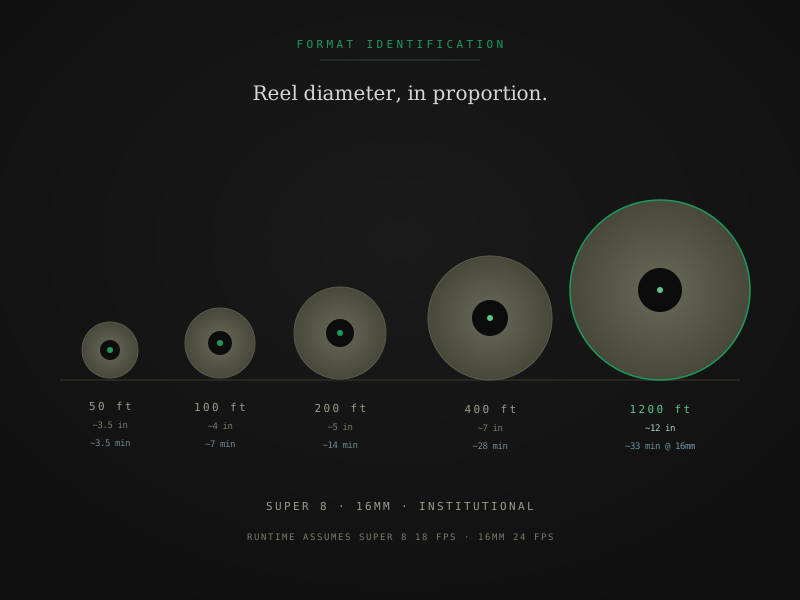
A reel of film looks like a reel of film. The footage it holds depends on the diameter, the format, and how full the original photographer or editor wound it. This is a practical reference for matching what you can see (the reel diameter) to what you have (footage and runtime), without unspooling anything.
The diameter-to-footage chart
| Reel diameter | Approximate footage | Format / context |
|---|---|---|
| 3 in (~75mm) | 50 ft | Smallest Super 8, 8mm, or short 16mm |
| 4 in (~100mm) | 100 ft | Mid-size Super 8 / 8mm |
| 5 in (~127mm) | 200 ft | Largest common Super 8 / 8mm |
| 7 in (~178mm) | 400 ft | Common 16mm and small 35mm |
| 9 in (~228mm) | 800 ft | Larger 16mm |
| 12 in (~305mm) | 1,200 ft | Large 16mm and 35mm |
| 14 — 15 in (~360mm) | 1,600 — 2,000 ft | Institutional and cinema reels |
The relationship is roughly linear with diameter. A reel with twice the diameter holds about four times the footage, because the area scales as the square of the radius. The chart above is consistent enough across formats that a 5-inch reel is 200 feet whether it’s Super 8, 8mm, or 16mm — though the runtime differs because the formats have different frame rates and frame sizes.
Common sizes by format
Super 8
Super 8 reels usually come in three sizes:
- 50 ft — the standard cartridge length, returned from processing on a small reel
- 200 ft — a larger reel often used for editing or compiling multiple cartridges
- 400 ft — rare; usually a custom assembly of multiple processed cartridges
Most family Super 8 collections are dominated by 50-ft reels because that’s what came back from the lab after each shooting session. Large compiled reels (200 ft+) usually mean someone in the family did editing.
Standard 8mm
Standard 8mm reels follow the same diameter-to-footage chart, with most home-movie collections containing 50-ft and 100-ft reels. 200-ft Standard 8mm reels exist but are less common than in Super 8.
16mm
16mm runs at higher frame rates and was typically shot for longer-form content, so reel sizes are bigger:
- 100 ft — the standard 16mm camera load, common for amateur and educational use
- 400 ft — the workhorse size for documentary and educational 16mm
- 800 ft and 1,200 ft — common in institutional collections, professional documentary, and historical archives
- 1,600 ft and 2,000 ft — larger institutional reels, often pre-assembled compilations
A 16mm collection dominated by 100-ft reels usually means amateur or short-form content. 400-ft reels suggest serious documentary or educational use. 800-ft and larger usually mean institutional or professional origin.
35mm
35mm uses larger reels because the format itself is wider and the frame rate is higher:
- 400 ft — the smallest common 35mm reel, typical for amateur or educational work
- 1,000 ft — the standard cinema reel size for theatrical projection
- 2,000 ft — common for studio masters and longer cinema reels
For 35mm, the format is uncommon enough in home-movie collections that any 35mm reel deserves treating as institutional-grade material until proven otherwise.
Runtime by format
Footage and runtime are different. The same 50 feet of film produces different runtime depending on format and frame rate:
| Format | Frame rate | Runtime per 50 ft | Runtime per 100 ft | Runtime per 400 ft |
|---|---|---|---|---|
| Super 8 (silent) | 18 fps | ~3.5 min | ~7 min | ~28 min |
| Super 8 (sound) | 24 fps | ~2.5 min | ~5 min | ~21 min |
| Standard 8mm | 16 fps | ~3.5 min | ~7 min | ~28 min |
| 16mm (silent) | 24 fps | ~1.4 min | ~2.8 min | ~11 min |
| 16mm (sound) | 24 fps | ~1.4 min | ~2.8 min | ~11 min |
| 35mm | 24 fps | ~33 sec | ~1.1 min | ~4.4 min |
The frame-rate difference is structural. Super 8 home movies were typically shot at 18 fps to save on film stock. Sound Super 8 ran at 24 fps. 16mm runs at 24 fps almost universally. 35mm runs at 24 fps for cinema and various other rates for specialty work.
Why this matters: a 200-ft 16mm reel and a 200-ft Super 8 reel cost roughly the same to scan (per-foot pricing is identical) but produce different runtimes. The 16mm reel is about 7.5 minutes; the Super 8 reel is about 14 minutes. If you’re estimating runtime for a project that needs a specific viewing length, the format matters.
How to estimate footage from a closet of reels
A quick inventory method that works for any consumer collection:
- Count reels by approximate diameter: how many small (3 to 5 inches), how many medium (5 to 7 inches), how many large (7+ inches).
- Multiply by typical footage: small ~50 to 200 ft each, medium ~200 to 400 ft each, large ~400 to 1200 ft each.
- Sum.
- Add 20 to 30 percent slack for partial reels and miscounting.
A typical American family Super 8 collection lands somewhere between 1,000 and 3,000 feet of total film — about 15 to 50 short reels totaling roughly an hour to several hours of footage. Larger collections from filmmaking-inclined families can run 5,000 ft or more. Institutional collections regularly run into tens of thousands of feet.
For ordering at FPL, footage estimates within 10 to 20 percent of actual are perfectly fine. We measure exact footage at intake, and the final invoice reflects the measured length. The estimate you submit is informational, not a binding commitment.
What this means for cost
Pricing is per foot. The rates at FPL apply to the measured footage of each reel:
- Access $0.42/ft for Super 8, 8mm, 16mm
- Preservation $0.98/ft for the same formats
- Archival $1.65/ft for the same formats
- 35mm runs $0.68 / $1.45 / $2.35/ft for the three tiers
So a single 200-ft Super 8 reel at Preservation tier is $196 in scanning, plus per-category handling. A full 400-ft 16mm institutional reel at Archival is $660 in scanning. The full per-tier pricing including handling fees and minimums is on the pricing page.
For collections above 2,000 ft of film footage, a 10 percent bulk discount applies automatically to the overage portion. So a 3,500-ft Super 8 collection at Preservation tier pays $0.98/ft on the first 2,000 ft and $0.88/ft on the remaining 1,500 ft.
What we do at intake
When your reels arrive, we measure exact footage of each reel before scanning. The measurement is mechanical — the scanner’s transport reports footage as it advances. The measured number is what shows up on your invoice, not your original estimate. If your estimate was high, the final invoice is lower; if it was low, the invoice is higher. Either way, the per-foot rate is what was quoted, and the math is straightforward.
For a deeper walkthrough of how the intake-to-invoice flow works, including the condition report and approval steps that happen between intake and scanning, how it works is the customer-experience guide. For format-by-format identification before you measure anything, how to identify your film format is the starter piece.
The shortest version
If you remember three things:
- Diameter scales with footage. A 3.5-inch reel is 50 ft, a 5-inch reel is 200 ft, a 7-inch reel is 400 ft. Format-independent.
- Runtime depends on format and frame rate, not just footage. The same 200 ft is 14 minutes of Super 8 silent or 7 minutes of 16mm.
- Estimates within 10 to 20 percent are fine for ordering. Exact footage gets measured at intake, and the per-foot rate is what you were quoted.
You don’t need to unspool anything. A ruler against the side of the reel, a quick chart lookup, and a rough count of reels gets you a usable footage estimate in under five minutes.
Quick answers from the bench
- Measure the reel diameter with a ruler. A reel about 3.5 inches across is typically 50 feet. 4 inches is roughly 100 feet. 5 inches is 200 feet. 7 inches is 400 feet. Larger reels in the 9 to 12 inch range are 800 to 1600 feet, common for 16mm professional and institutional collections. The relationship between diameter and footage is consistent enough across formats that a quick measurement gets you within roughly 10 percent.