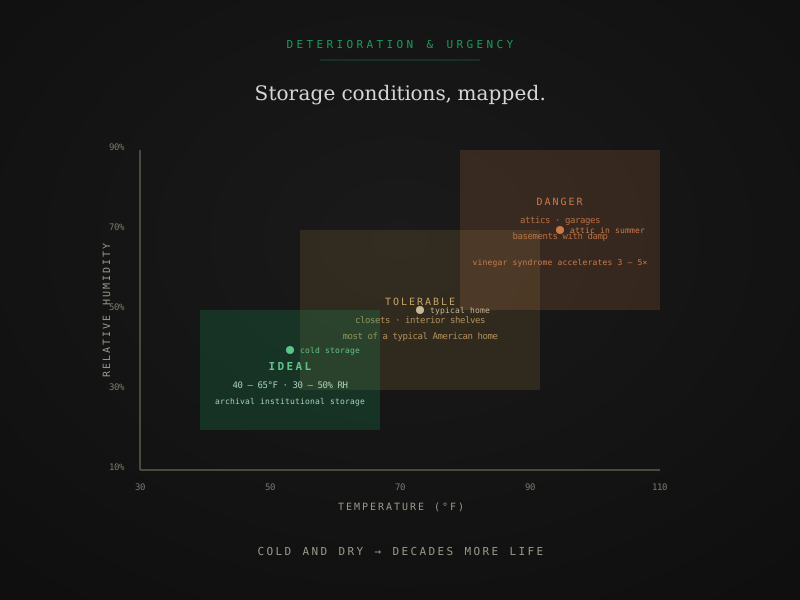
Storage is the single biggest factor in how long your film actually survives, and it’s the most under-discussed step in home-movie preservation. People worry about whether to digitize. They obsess over which lab to use. They rarely look at the closet they’re storing the reels in — even though that closet, more than anything else, determines how much time they have.
This is a practical guide for households, not institutional vaults. The goal isn’t archival-grade preservation; it’s buying enough time to digitize, with whatever space you actually have.
The two variables that matter most
Storage chemistry comes down to two things: temperature and humidity. Everything else — container choice, light exposure, dust, handling frequency — is real but secondary.
Temperature drives the rate of chemical decay. The major deterioration processes (acetate hydrolysis, dye fading, base shrinkage) all accelerate with heat. A rough rule from preservation chemistry: chemical reactions roughly double in rate for every 18 degrees Fahrenheit of temperature increase. The practical implication: film stored at 90°F (a typical attic in summer) ages roughly 3 to 5 times faster than the same film at 65°F (a typical interior closet).
Humidity drives the same chemistry plus mold growth. High humidity (above ~60% relative humidity) accelerates acetate decay and creates conditions where mold can colonize the film surface. Low humidity (below ~30% RH) slows chemistry but can make some film stocks brittle over decades. The sweet spot is somewhere in the middle, and most American interior spaces hit it without intervention.
For most households, the goal is below 70°F and below 50% RH. That’s achievable in most interior closets without any special equipment.
What this means in practice
The single biggest storage move — the one with the largest payoff for the lowest effort — is moving film out of attics, garages, and basements.
Attics
Hot in summer (often 100°F+), cold in winter, with daily temperature swings that stress film mechanically. Acetate decay accelerates 3 to 5x in summer-attic conditions. If your reels are in an attic now, this is the highest-priority change you can make today, at zero cost.
Garages
Slightly less extreme than attics on temperature, but typically poorly insulated, with high humidity in many climates and dust exposure. Same recommendation: move them indoors.
Basements
Variable by climate. Damp basements (common east of the Mississippi, anywhere with high water tables) are bad for film — high humidity year-round, occasional flooding, mold risk. Dry basements (common in arid Western climates) are tolerable but tend to be cooler than ideal in winter. Default recommendation: move film to interior space if at all possible; if a basement is the only option, choose the driest part and add a small dehumidifier if needed.
The good news
Almost every American household has some interior space where conditions are acceptable. A bedroom closet, a hall shelf, the back of a kitchen pantry, or under-bed storage all qualify. The conditions don’t need to be perfect — they need to be interior (climate-controlled by the house’s normal heating/cooling), away from heat sources (fireplaces, water heaters, sunny exterior walls), and not damp.
Step-by-step: setting up household storage
A practical sequence for someone who just inherited a box of reels and wants to do this once:
1. Pick the right room
Interior, ground-floor or above-grade, away from exterior walls. A spare bedroom closet, a hallway shelf, or a hall closet all work. Avoid:
- Anywhere near a fireplace, water heater, or major appliance
- Sunny rooms with direct exposure to summer afternoon light
- Bathrooms (humidity from showers)
- Kitchens (humidity from cooking, occasional grease vapor)
- Garages, attics, basements (already covered)
2. Decide on a container
Three reasonable approaches, in increasing order of effort:
Original cans, stacked or in a box. Whatever the reels arrived in is usually fine. Metal cans don’t off-gas and provide good physical protection. The downside: sealed metal cans trap acetic acid vapor on reels with active vinegar syndrome, accelerating decay. Fine for healthy reels; risky for affected ones.
Plain plastic bin or cardboard box, reels in their own bags. A clean cardboard box or food-grade plastic bin, with each reel in its own paper bag or plastic ziplock. Lets vapor escape from individual reels without contaminating neighbors. The right answer for a mixed collection where some reels show vinegar symptoms.
Archival storage cans. Chemically inert plastic cans with vented lids, available from preservation suppliers. The institutional standard. Worth the cost only for reels you genuinely care about and intend to keep long-term — not necessary for the typical household collection.
3. Separate affected reels from healthy ones
If the smell test reveals reels with vinegar syndrome, put them in their own container, in a different part of the storage room (or a different room entirely if space allows). Vinegar syndrome spreads through air contact — an affected reel in the same sealed bin as 12 healthy reels can pull all 13 toward decay over a few years. Physical separation prevents this.
For deeper coverage of vinegar syndrome specifically, vinegar syndrome — the complete guide covers stages and recoverability, and what does vinegar syndrome smell like? covers the smell test in detail.
4. Add a label
A simple inventory label on the storage container saves future-you (or the next family member) time. What to include: number of reels, formats present (Super 8, 8mm, 16mm), approximate years of footage, and a date for “last checked.” Re-checking annually is plenty for most collections.
5. Leave it alone
Storage works best when the conditions are stable. Frequent handling, repeated opening and closing of containers, and moving reels around all introduce mechanical and humidity stress. Once you’ve set up storage, the right next move is to leave it alone until you’re ready to digitize.
What about the reels themselves?
The reels (the physical metal or plastic spools the film is wound on) are typically fine as-is for storage. Two exceptions worth knowing:
Cracked or warped reels
A reel that has cracked, warped, or lost rim integrity should be replaced. The risk is that the failed reel deforms the film wound on it, introducing curl or edge damage. New plastic industry-standard reels are inexpensive and available from photography suppliers; for most home collections, replacement is unnecessary.
Brittle film tightly wound
If the film itself feels brittle, do not try to rewind or transfer it to a different reel at home. Brittle film snaps under tension. Leave it on whatever it’s wound on, store it gently, and let a lab handle any rewinding during the intake process.
Refrigerator and freezer storage
For most home collections this is unnecessary, but the question comes up enough to address briefly:
Refrigerator storage at ~40°F roughly halves the rate of acetate decay versus room temperature. Useful for rare or particularly important reels. Requires sealing the reels in airtight bags with desiccant before refrigerating, and warming each reel slowly back to room temperature (typically overnight) before opening to prevent condensation damage.
Freezer storage at 0°F slows decay more dramatically — roughly 10x slower than room temperature. The same warming and sealing protocol applies, plus extended warming time. Freezer storage is reasonable for one or two genuinely irreplaceable reels; not practical for an entire collection.
For typical American family collections, room-temperature interior storage is the practical answer. The marginal benefit of refrigeration over a good closet is real but small compared to the marginal benefit of moving film out of an attic or garage in the first place.
Light, dust, and other secondary factors
A few smaller variables worth mentioning:
Light
Direct sunlight degrades film via UV exposure. Indirect ambient light is fine. Storage in a closed container or closet handles this automatically; you don’t need to worry about light if the reels are in cans or bags.
Dust
Surface dust is mostly cosmetic and gets cleaned during the intake process at any quality lab. Avoid storage spaces with active dust sources (workshops, unfinished basements, attics with insulation fibers).
Magnetic fields
Largely a myth for film. Magnetic fields don’t affect the chemical or physical structure of film. They can affect magnetic sound stripes, but typical household magnetic exposure (refrigerators, speakers, wiring) is far below the threshold where it matters.
Vibration
Generally not a concern for film at rest. The exception is reels stored near major appliances (washing machines, HVAC compressors) where sustained vibration can compress windings unevenly over years. Move them away from those sources if it’s easy; don’t obsess over it if it isn’t.
When storage becomes urgent
Three signals that the storage clock is running faster than the chart suggests:
- A reel has developed a vinegar smell since the last check. Active acetate decay; plan to digitize this reel within 12 months.
- A reel is visibly warping or cupping. Stage 2 or later of vinegar syndrome; digitize within 6 to 12 months.
- Mold or moisture damage is visible. Address the storage conditions immediately and digitize the affected reels promptly.
For everything else, storage is a slowing strategy — it buys time for digitization, which is the only way to actually preserve the image content long-term.
For the broader urgency framing across all film deterioration, film deterioration — what’s happening to your film right now walks the categories.
The shortest version
If you remember three things:
- Move out of garages, attics, and basements. This single change has more impact than anything else.
- Interior closet at room temperature is the practical target. You don’t need archival vaults; you need the inside of your house.
- Separate affected reels from healthy ones. Vinegar syndrome spreads. Physical separation is free and meaningful.
Storage buys time. Digitization preserves. Both matter; the order is do-storage-now-then-digitize-when-you-can. Don’t let the perfect storage setup become the reason you defer the actual preservation work.
Quick answers from the bench
- Cold storage at archives runs 40 degrees Fahrenheit and 30 percent relative humidity. That is the institutional preservation standard and is impractical for most households. The realistic home target is below 70 degrees Fahrenheit and below 50 percent humidity — conditions found in most American interior closets. Going colder slows decay faster, but the curve flattens once you're below room temperature. The biggest gains come from getting out of garages and attics, not from refrigerating reels.