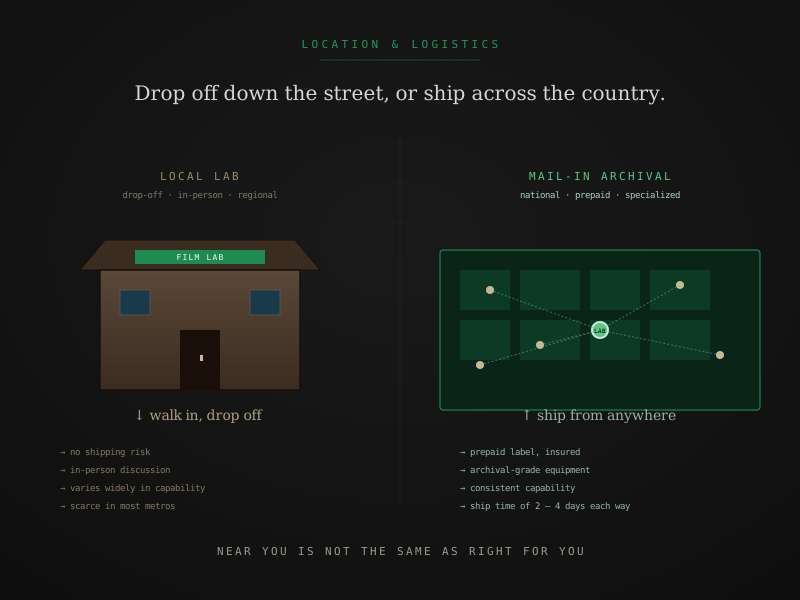
If you searched “film digitization near me,” you’re probably looking for one of three things: a place to drop reels off in person, a service close enough to feel trustworthy, or a way to avoid shipping fragile film through the mail. Each of those is reasonable. Each leads to a slightly different right answer.
This is a practical guide to evaluating local film labs against national mail-in services, with honest framing about when local is the right call and when geography is doing less work than the search query implies.
The honest version up front
A great local film lab is excellent. A mediocre local lab is worse than a great national mail-in service. The variation between vendors in capability is much wider than the variation between local and remote delivery models.
What that means practically: don’t default to local just because it’s nearby. Don’t default to mail-in just because it’s common. Use the same evaluation criteria on both, and pick the vendor whose actual capability matches your project — regardless of whether you drove to them or shipped to them.
When local matters
Three situations where local is genuinely the better answer:
1. Large institutional or commercial projects
Institutional film collections, broadcast archives, and university libraries often benefit from in-person intake conversations. The collection manager wants to walk through the material with the lab, identify edge cases, and discuss documentation requirements before shipping anything. That kind of consultative relationship works better when you can drive to the lab and have a meeting.
For these projects, local is often a real advantage — assuming a qualified local lab exists in your metro.
2. Truly irreplaceable footage requiring intake-side decisions
Some reels warrant inspection before they leave your possession. Documentary originals from a known event, the only known copy of historically significant footage, severely deteriorated material where decisions about scanning approach need to be made hands-on. A national mail-in lab can do an excellent scan of these reels — but the decision about how to handle them sometimes benefits from in-person discussion.
3. When shipping is genuinely impractical
For most American customers, a prepaid FedEx or UPS label and a sturdy box is straightforward. For some — rural locations far from carrier facilities, customers without reliable carrier infrastructure, customers with mobility constraints — shipping introduces real friction that local drop-off avoids.
This is a smaller share of customers than the “near me” search volume implies, but it’s real.
When local is doing less work than it looks like
Three patterns where local feels like an advantage but isn’t actually:
1. The capability gap is wider than the geography gap
A skilled local lab using a Lasergraphics ScanStation produces archival-grade output. A consumer-tier local shop using a projector-camera setup produces casual-viewing output. Both are local; the quality gap between them is enormous. National mail-in labs sit somewhere on the same spectrum — some excellent, some less so — but the local-vs-remote axis isn’t the one that determines output quality.
The question that matters is what equipment, what process, what output formats — not how far away. For deeper coverage of how to evaluate this, 10 questions to ask before choosing a film digitization service walks the criteria.
2. Shipping is statistically safer than driving
Insured tracked FedEx or UPS shipping with proper packing has a damage-and-loss rate on the order of 1 in 1,000+ shipments. The packaging absorbs shock, the routing is climate-controlled at major hubs, and tracked status means you know exactly where your reels are at any moment.
Driving across a major metro with film reels in your trunk on a 95-degree summer day is sometimes worse for the film than a properly packed cross-country shipment. The risk math depends on conditions, but the intuition that “local is safer” isn’t reliably true once you account for actual transport conditions.
3. Many “local” results are mass-market services with retail partners
Searches for “film digitization near me” routinely surface Costco photo centers, CVS, Walgreens, and other big-box retail programs. These aren’t local film labs — they’re drop-off points for mass-market mail-in services like Yes Video and similar. Your reels get shipped from the retail counter to a central processing facility hundreds or thousands of miles away, the work happens at that central facility, and the output comes back through the retail partner.
For framing on what these mass-market services produce, Legacybox vs professional film scanning walks the comparison.
How to find a real local film lab
If local is the right fit for your project, the search query “film digitization near me” isn’t the most useful starting point. Better approaches:
Search by service term + city
Try queries like:
- “film transfer [your city]”
- “8mm scanning [your city]”
- “Super 8 digitization [your city]”
- “16mm film transfer [your city]”
Format-specific terms surface specialist labs that “near me” queries often miss.
Check directories maintained by archival communities
The Center for Home Movies maintains a directory of preservation-aware labs at homemovieday.com. Most labs in their network have been vetted for archival-grade work and can handle the typical home-movie collection responsibly.
The Association of Moving Image Archivists (AMIA) maintains a member directory at amianet.org — primarily institutional, but useful for finding professional labs.
FilmCollecting forums and r/AnalogCommunity sometimes have user-submitted vendor recommendations by city.
Look for specific markers of legitimacy
- A physical address you can verify
- Named principals or operators
- Specific scanner make and model in their public materials
- Sample work visible online or available on request
- Realistic turnaround estimates
- Honest pricing tiers (per foot or per reel, not per box)
Vague online presence with no physical address is a yellow flag regardless of geography.
How to evaluate a local lab once you find one
Use the same 10-question vendor checklist that applies to any digitization service:
- What scanner do you use, by make and model?
- What is the native capture resolution off the film?
- Is the transport sprocketless?
- What output formats do I receive at each tier?
- What is your damaged-film policy?
- Do you quote surcharges before scanning?
- How are originals returned?
- What chain of custody documentation do you provide?
- How are files delivered, and what is retention?
- What is the realistic turnaround?
For deeper coverage of what good answers look like and what red flags to watch for, 10 questions to ask before choosing a film digitization service is the longer reference.
The criteria don’t change based on geography. A great local lab will answer all 10 questions clearly and specifically; a great mail-in lab will too. A vendor that hedges or evades is worth skipping regardless of distance.
When mail-in is the right answer
For most home-movie collections, mail-in is the practical default for three reasons:
1. Capability range is wider
National mail-in labs typically have higher capital investment in equipment, more specialized operators, and broader format coverage than the average local shop. The exception is major-metro labs that compete on quality and have built archival-grade pipelines — but those are the minority of local options.
2. Pricing is often more competitive
A national mail-in lab amortizes its equipment cost across more customers and often prices more aggressively than a local shop with regional cost structure. The price-to-quality ratio at a good mail-in lab is hard to beat for typical consumer projects.
3. The shipping model is well-established
Prepaid carrier labels, insured tracked shipping, and structured intake-to-delivery workflows are the standard at any reputable mail-in lab. The customer experience is designed around the shipping flow — box arrives at lab, condition report sent within a few business days, scanning, QC, delivery, originals return-shipped insured. The whole thing is more polished and less ad-hoc than most local-lab walk-in flows.
For a deeper walk-through of what the mail-in customer experience actually looks like end-to-end, how it works covers the 10 customer touchpoints and timing.
A practical decision framework
Three questions that resolve local-versus-mail-in cleanly:
Question 1: Is the project unusually consultative or large?
- Yes (institutional, broadcast, irreplaceable, frame-level restoration) → local can be a real advantage if a qualified lab exists in your metro
- No (typical home-movie collection, casual or family-archive intent) → mail-in is usually fine
Question 2: Are you comparing local quality to mail-in quality, or just to closeness?
- Comparing quality (you’ve verified the local lab against the 10-question checklist and they answer well) → local is a legitimate choice
- Comparing closeness only (the local option is convenient but you haven’t verified capability) → the geography isn’t doing what you think it is
Question 3: Do you have actual logistical constraints on shipping?
- Yes (rural area, mobility constraints, no reliable carrier) → local matters more
- No (typical urban or suburban with FedEx/UPS access) → shipping is straightforward
A reasonable hybrid for some collections
For collections with a mix of priorities — some reels you genuinely want to discuss in person and others that are routine — the hybrid pattern is:
- Triage the collection by importance. The smell-test and visual inspection from film deterioration: what’s happening to your film right now gets most of this done.
- Bring the most-important or most-fragile reels to a qualified local lab for a hands-on assessment, if one exists in your metro.
- Send the rest to a national mail-in lab for the routine bulk of the work.
This is rarely necessary — most collections fit cleanly into one model or the other — but it’s a real option for collections where the trade-off matters.
Where FPL fits
FPL is a national mail-in archival lab. We don’t have a local drop-off operation in any specific city. The customer experience is built around prepaid FedEx and UPS shipping labels, insured tracked transport both directions, a magic-link order-tracking page, and email communication throughout the project.
For most customers, this is the right model. For customers who need or prefer an in-person assessment, we honestly recommend exploring qualified local labs first — if your metro has one with archival-grade capability, that’s a legitimate alternative. The Center for Home Movies directory is a good starting point.
If you want to evaluate FPL specifically against the 10-question checklist, the answers are documented at 10 questions to ask before choosing a film digitization service.
The shortest version
If you remember three things:
- Local doesn’t mean qualified. Capability varies enormously between vendors regardless of distance.
- Mail-in shipping is statistically safe with insured tracked carriers and proper packing. The intuition that local is safer is often not borne out.
- Use the same 10-question checklist on both. The criteria are about equipment, process, and output — not about how far away the lab is.
For most American home-movie collections, a qualified mail-in archival lab outperforms an average local lab on output quality and offers comparable or better safety. For projects with genuine in-person needs, a vetted local lab can be the right call. Geography is one variable among many, not the dominant one.
Quick answers from the bench
- No. Insured tracked carrier shipping with proper packing is statistically very safe — losses and damage are rare on the order of 1 in 1,000+ shipments. Driving across a major metro with film in your trunk on a hot day is sometimes worse for the film than a properly packed cross-country shipment. The risk math depends on packing quality and condition. For most home-movie collections, mail-in via prepaid label is statistically about as safe as local drop-off.