The film digitization market is full of services that look similar from the outside. Marketing copy is consistent: professional, archival, high-quality, fast turnaround, satisfaction guaranteed. The actual differences live below that surface, in the technical specifics that don’t make it onto landing pages.
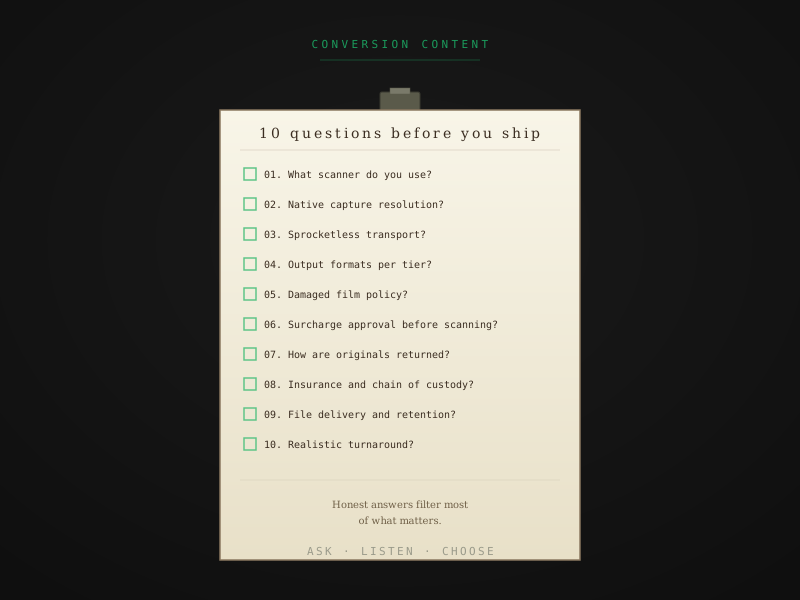
This is a practical checklist of ten questions to ask any vendor before you send them your reels. The questions work on mass-market services, professional labs, and institutional facilities — calibrated differently for each, but the substance is the same. We use the same questions on FPL, and we’ll tell you how we answer at the bottom of the article.
How to use the list
Send the questions in writing — email or contact form — before committing to a service. Compare the answers side-by-side across two or three vendors you’re considering.
What you’re looking for:
- Specificity. Real answers reference specific equipment, specific resolutions, specific file formats, specific policies. Vague answers signal either ignorance or evasion.
- Consistency. A vendor whose answers contradict each other across questions, or contradict what their landing page says, is a yellow flag.
- Match to your project. A vendor’s honest answers might rule them out for your specific project — that’s good information, not a problem.
The 10 questions
1. What scanner or transfer equipment do you use, by make and model?
Real frame-by-frame scanners have a manufacturer and model number. Common professional scanners:
- Lasergraphics ScanStation, Director
- Filmfabriek HDS+, Pictor
- BlackMagic Cintel
- MWA Nova Choice, Flashscan
- Sondor various professional models
A vendor who answers with one of these names, or another specific scanner make/model, is running a real frame-by-frame setup. A vendor whose answer references “professional equipment” or describes a projector-and-camera setup is running a different process — possibly fine for casual-viewing output, but not the same category.
For deeper coverage of how the equipment difference shows up in the file, projector transfer vs film scanner walks the comparison.
2. What is the native capture resolution off the film at each tier?
The answer should be specific (2K, 4K, 6K, etc.) and refer to what the scanner sensor reads off the film, not what the output file encodes to.
A vendor that says “our scans are 4K” without specifying whether that’s capture or output is hedging. The capture resolution is the ceiling of the file’s detail; everything else downstream just compresses or downscales from that ceiling.
For deeper coverage of how capture resolution interacts with output format, 2K vs 4K film scanning and ProRes, DPX, H.264 — choosing your output format cover the spec.
3. Is the film transport sprocketless?
Yes-or-no question. Sprocketless transport holds film by its edges instead of engaging the perforations — the modern standard for any service handling older or potentially damaged film. Sprocket-driven transport uses mechanical teeth on the perforations and tears damaged film.
If the answer is no, or hedged, ask whether the service handles film with vinegar syndrome, brittleness, or damaged perforations. The honest answer is usually that it doesn’t.
For deeper coverage of why this matters, sprocketless film transport walks the engineering.
4. What output formats do I receive at each pricing tier?
A real archival lab delivers a master file (ProRes or DPX), an editorial intermediate, and an access copy — not just a single H.264 MP4. The number and type of deliverables tells you whether the service is built around long-term file utility or short-term casual viewing.
Useful sub-questions:
- Bit depth at each tier? (8-bit / 10-bit / 12-bit / 16-bit)
- Color space? (Rec. 709 / log / ACES)
- File container? (.mov / .mp4 / DPX sequence / TIFF sequence)
- Audio capture, when applicable?
A vendor who can’t answer those follow-ups is producing whatever the encoder defaults to, not making informed decisions about your file’s downstream usefulness.
5. What is your damaged-film policy, and how do you handle reels with vinegar syndrome, brittleness, or shrinkage?
The right answer for a professional lab includes:
- Sprocketless transport that handles up to ~2 percent shrinkage
- Inspection at intake with a written condition report before chargeable work
- Quoted surcharges (where applicable) for damage-related extra labor
- Honest referrals when material is beyond the lab’s capability
A vendor who refuses damaged film, or accepts it without specifying how it’s handled, is signaling that this isn’t their pipeline. That’s fine for healthy film — but you should know it before shipping any reels with active deterioration.
For deeper coverage of what damaged-film handling actually involves, vinegar syndrome — the complete guide and film deterioration: what’s happening to your film right now walk the symptom-and-recovery framework.
6. Do you quote surcharges before scanning, and is there a customer-approval window?
The honest pattern for any archival lab:
- Reels arrive at the facility
- Intake inspection produces a condition report
- Any damage-related surcharges are quoted to the customer in writing
- Customer approves or declines each surcharge individually
- Only after approval does chargeable work begin
A vendor who applies surcharges without explicit approval — even small ones — is making decisions on your behalf you didn’t authorize. A vendor who waits indefinitely for approval is also problematic; ask what happens if you don’t respond. (FPL’s answer: 14-day window, after which we proceed with the standard scope and any surcharges become negotiable at final invoice rather than auto-applied.)
7. How are originals returned, and what insurance applies?
Originals should always be returned. Some discount services keep them. Some keep them by default unless you opt in to return shipping. Some return them via uninsured ground service.
The right answer for most projects: insured, tracked return shipping with declared value covering the replacement cost of the originals. Some labs build this into the project price; some bill it separately at cost. Both are legitimate, but you want to know which.
8. What chain of custody and quality control documentation do you provide?
Especially relevant for institutional or rare collections, but useful even for family archives:
- Photographs of the package and reels at intake
- A written condition report
- Documented handoffs between intake, scanning, post-processing, QC, and delivery
- A signed attestation letter (for institutional projects requiring FADGI-informed documentation)
A vendor who has this documentation as standard has a process. A vendor who can produce it on request when they don’t produce it by default has a partial process. A vendor who can’t produce it at all has no process — which doesn’t necessarily mean bad work, but means you can’t verify what happened to your reels at any specific stage.
9. How are files delivered, and what is the retention policy?
Delivery options to ask about:
- Cloud-based portal (Vault, web download, etc.)
- USB drive, hard drive, or SSD
- Secure file transfer (SFTP, institutional file transfer)
- DVD or Blu-ray disc
Retention policy:
- How long does the vendor keep files after delivery?
- Can you re-download if you lose your local copy?
- Is there an ongoing storage cost or is initial delivery a one-time fee?
Some services delete files within 30 days of delivery; some retain for a year; some retain indefinitely with an annual subscription model. Both can be legitimate, depending on what the customer wants — you just want to know which it is before you commit.
10. What is the realistic turnaround, including peak-season delays?
Marketing turnaround claims are often best-case. Ask:
- What is the typical turnaround for a project of my size?
- What is your busy season, and how does turnaround change during it?
- Do you provide status updates during the project?
- What happens if my project takes longer than quoted?
A professional consumer lab typically runs 3 to 5 weeks for standard projects and 4 to 6 weeks for institutional or 35mm. Mass-market services often advertise 6 weeks but run 8 to 12 during peak season (October through January is busiest for most services as customers prepare gifts).
If a vendor quotes 2 to 3 weeks across the board with no qualifications, ask follow-up questions. Either they have unusual capacity or they’re quoting a best case that won’t materialize on your project.
Bonus question 11: Are you willing to do a small pilot scan first?
For institutional projects or large family collections, asking for a small pilot — one or two reels scanned at the proposed tier — is reasonable and useful. A vendor confident in their pipeline will accommodate this. A vendor who refuses pilots is signaling either operational inflexibility or unwillingness to be evaluated against actual output quality.
At FPL, we offer free pilot scans for institutional projects (50 to 100 ft of representative footage) precisely because evaluating a vendor on a pilot is faster and more reliable than evaluating on marketing materials.
A red-flag list
Some specific patterns that warrant extra caution:
- Specific guarantees about quality without measurable criteria. “100% satisfaction guaranteed” is meaningless without a defined standard.
- Pricing that’s significantly cheaper than category norms. Mass-market services run $15 to $30 per item; professional labs run $50 to $400+ per reel. A service charging $5 per reel for “professional archival quality” is selling something different than what they advertise.
- No physical address or accountability. Reputable labs have a verifiable physical location and named principals.
- Refusal to provide written answers. A vendor who insists on phone-only conversations is harder to evaluate and harder to hold accountable.
- Promises about turnaround that conflict with capacity math. A small lab can’t actually scan 1000 reels per week, regardless of what the marketing copy says.
How FPL specifically answers these questions
In the spirit of using the same checklist on ourselves:
- Equipment: Lasergraphics ScanStation
- Native capture resolution: 2K at Preservation, 4K at Archival, up to 6.5K available for institutional 35mm
- Sprocketless transport: yes
- Output formats: Access — H.264 1080p; Preservation — ProRes 422 HQ + H.264; Archival — DPX 16-bit log + ProRes 4444 XQ + H.264
- Damaged film policy: handled up to 2% shrinkage; severe deterioration referred to specialist labs (TMTV in Nelson, BC; Library of Congress Packard Campus for nitrate)
- Surcharge approval: condition report sent at intake; 14-day customer approval window; surcharges become negotiable at final invoice if no response
- Originals: always returned via insured tracked FedEx or UPS
- Chain of custody: documented at four handoffs; signed attestation letter available for institutional projects
- File delivery: Vault portal with one-year retention included; longer retention available
- Turnaround: 3 to 5 weeks consumer; 4 to 6 weeks 35mm and institutional; honest peak-season communication
The full pricing rate card is on the pricing page. The intake-to-delivery flow is on how it works. Detailed institutional capabilities are on the institutional service page.
The shortest version
If you remember three things:
- Marketing language is consistent across services. Technical questions surface the real differences.
- Send the same 10 questions to two or three vendors in writing. Compare side-by-side. The differences will surface what each vendor optimizes for.
- A vendor whose honest answers don’t match your project’s needs is showing you useful information — even if it rules them out. The right answer for your project is whichever vendor’s actual capabilities best fit what you actually have.
The goal of asking is not to find the perfect vendor — it’s to find a fit. The questions filter both directions. They tell you which vendors meet your needs, and they tell you which projects are wrong for which vendors. Both kinds of information save money and prevent post-purchase regret.
Quick answers from the bench
- Good ones will, in writing, with specifics. Vendors that hedge, redirect to marketing language, or refuse written answers are showing you something about how they operate. The clarity of the answer is itself most of what you need to know — even before you evaluate the substance of the answer.