For archivists evaluating a digitization vendor — or for anyone with film that’s been sitting in a closet long enough to worry about — the transport mechanism inside the scanner matters more than any other single piece of equipment. The film passes through the transport at the start of the scanning process, and a wrong choice there causes irreversible damage to material that may already be irreplaceable.
This is a plain-language explanation of what sprocketless transport is, what it solves, and why it’s the non-negotiable baseline for any project involving film that isn’t pristine.
The mechanical problem sprocketless transport solves
Film is moved through a projector or scanner by some mechanism that grips the strip and advances it frame by frame. The traditional approach — used in every projector and most older scanners — is sprocket-driven transport.
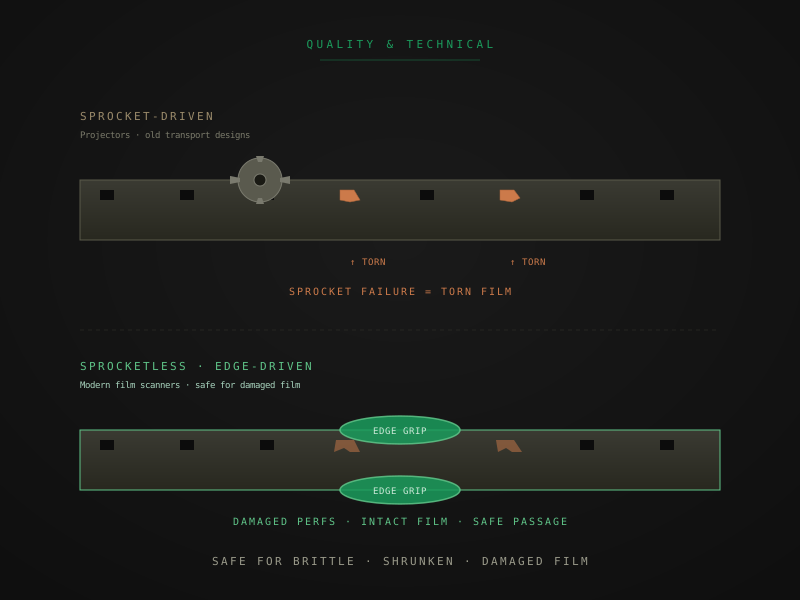
A sprocket-driven mechanism uses mechanical teeth, mounted on a rotating drum or claw, that engage the perforations along the edge of the film. The teeth pull the film through the gate by hooking into those perforations the way a chain engages a bicycle gear. The system is mechanically simple, fast, and reliable when the film is in good condition.
Sprocket-driven transport fails when the film is not in good condition. Three failure modes:
- Brittle film snaps when sprocket teeth pull on it under tension. The teeth engage; the perforations crack at the engagement point; the film tears.
- Damaged or worn perforations can’t be engaged reliably. The teeth slip past them or grab in the wrong position, jamming the transport or creating registration errors.
- Shrunken film has perforations that are no longer the right distance apart for the sprocket spacing. Above about 1 percent shrinkage, the teeth start engaging the wrong perforations or skipping them entirely.
For institutional collections, family archives older than about 50 years, and any film showing vinegar syndrome or other deterioration, all three failure modes are common — sometimes simultaneously. Running such film through a sprocket-driven transport doesn’t just produce a worse scan. It actively damages the film further.
What sprocketless transport actually does
Sprocketless transport replaces the sprocket-tooth engagement with an edge-driven grip. Two soft rollers, or in some scanner designs an air-bearing channel, grip the film along the non-image edges of the strip — the parts of the film width that don’t carry image information.
The strip is advanced by friction between the rollers and the film edges. Sprocket holes are not engaged. The transport doesn’t care whether the perforations are torn, missing, oversized, or shrunken — the grip is on the film body itself, not on the perforations.
The mechanical implication: damaged perforations no longer prevent scanning. A reel with completely torn-out sprockets can pass safely through a sprocketless transport. A reel with 2 percent shrinkage can be scanned cleanly. A brittle reel that would crack apart in a projector gate can be transported through a sprocketless scanner without further damage.
The structural advantages, in detail
Three direct consequences of edge-driven transport:
1. Brittle film passes safely
Brittle film — common in collections older than about 60 years, especially those stored in non-climate-controlled spaces — cracks under the tension of sprocket-tooth engagement. Sprocketless transport applies pressure on the film edges rather than pulling on the perforations, distributing stress evenly across the film body. Brittle reels that would shatter in a projector pass through a sprocketless scanner without breaking.
2. Shrunken film tracks correctly
Cellulose acetate film shrinks over time as the chemical structure breaks down. Once shrinkage exceeds about 1 percent, sprocket-driven transport mis-tracks — the perforations are no longer at the correct interval for the sprocket teeth. Sprocketless transport doesn’t reference the perforations at all, so the film tracks based on its own physical edges regardless of shrinkage. Routine sprocketless transports handle up to about 2 percent shrinkage without issue.
3. Damaged sprockets become irrelevant
Reels that have been projected many times, or that have suffered impact damage, often have torn or worn perforations along the edges. Sprocket-driven transport on such material either jams or further damages the perforations on each pass. Sprocketless transport scans these reels without engaging the damaged perforations at all — the existing damage is preserved as-is and the film image is captured cleanly.
Why this is the modern professional standard
Every reputable institutional and high-end consumer film scanner sold in the last decade uses sprocketless transport as the default. Major manufacturers and their flagship scanners:
- Lasergraphics (ScanStation, Director) — the workhorse of institutional and consumer-pro scanning labs in North America
- Filmfabriek (HDS+, Pictor) — popular in European institutional labs
- BlackMagic Cintel — consumer-pro tier, sprocketless on all current models
- MWA Flashscan Nova — institutional and broadcast tier
- Sondor — high-end audio-aware film transports
The shift to sprocketless transport happened progressively from the early 2000s through the mid-2010s as institutional preservation projects increasingly required handling of fragile material that older sprocket-driven scanners couldn’t safely process. By the time FADGI moving-image guidelines stabilized, sprocketless transport was the implicit baseline for any vendor claiming archival-grade capability.
For a deeper coverage of FADGI requirements and what institutional buyers should look for, FADGI compliance for film digitization walks the spec.
The limits of sprocketless transport
Sprocketless transport is not magic. It handles a wide range of damaged film safely — but not all damage. Three limits worth understanding:
1. Severe shrinkage past about 2 percent
Above 2 percent shrinkage, even sprocketless transport starts to struggle. The film is so dimensionally compromised that the transport can’t maintain the precise frame-to-frame spacing needed for clean capture. At this stage, specialist intervention is needed — wet-gate scanning, manual hand-threading, or solvent rehydration at dedicated facilities like TMTV in Nelson, BC, or the Library of Congress Packard Campus.
2. Edge damage
Sprocketless transport relies on the film edges being structurally intact. Reels with severe edge damage — torn edges, edge mold that has eaten into the strip, or reels that have been stored in conditions that compromised the edges — can’t be reliably gripped by edge-driven rollers. Some scanners have hand-threaded modes for this, but the success rate is variable.
3. Broken film and bad splices
Sprocketless transport handles damaged perforations gracefully. It does not handle a film that’s actually broken — either snapped through completely or held together by a structurally unsound splice. Such reels need splice repair (manual rebonding of breaks, replacement of failed cement or tape splices) before scanning, regardless of transport type. Most labs hand-inspect and repair splices as part of intake, before the reel ever reaches the scanner.
Why this matters for institutional projects
Three implications for collection managers, archivists, and grant-application writers:
For evaluating vendors: asking specifically about transport type is a fast filter. A vendor whose scanner is sprocket-driven is the wrong choice for any collection containing material older than about 30 years or showing any deterioration symptoms. A vendor whose scanner is sprocketless can handle the great majority of typical institutional collection material safely.
For grant applications: referencing sprocketless transport in the technical section of a digitization proposal signals that the project will preserve fragile material rather than damage it. Grant reviewers familiar with film preservation recognize this as the expected baseline. Omitting it can read as either ignorance of the technical landscape or a willingness to accept lower-grade vendor capability.
For pilot scans: if a vendor offers pilot scanning, request that the pilot include at least one reel from the older or more fragile portion of the collection. This is the test that surfaces transport-quality issues before commitment.
For deeper coverage of vendor evaluation specifically, FADGI compliance for film digitization covers the institutional buyer’s evaluation framework.
How to spot a non-sprocketless scanner
Three quick tests if a vendor isn’t explicit about transport type:
- Ask the scanner make and model. Cross-reference: every modern professional scanner from the manufacturers listed above is sprocketless. If the vendor uses an older scanner from the 1990s or early 2000s, it may be sprocket-driven.
- Ask whether the scanner can handle 2 percent shrinkage. A sprocketless scanner can; a sprocket-driven one usually can’t.
- Ask how the scanner handles film with torn perforations. A sprocketless scanner scans it without further damage. A sprocket-driven scanner either refuses or causes additional perforation damage.
Services using projector-based transfer methods (camera pointed at projected image) are not running a scanner of either kind — they’re running a projector and a camera. Projector-based transfer carries all the risks of sprocket-driven transport plus the additional optical losses of the projection step. For more on that comparison, projector transfer vs film scanner is the longer piece.
The shortest version
If you remember three things:
- Sprocketless transport grips the film by its edges, not by the perforations. Damaged sprockets stop being a problem.
- It’s the modern standard for institutional and high-end consumer scanning. Every reputable manufacturer’s flagship scanner uses it.
- For any collection containing older or potentially damaged material, sprocketless transport is the non-negotiable baseline. Sprocket-driven transport on damaged film causes irreversible further damage that no scan quality can recover.
If you’re evaluating a vendor and the answer to “is your scanner sprocketless?” is anything other than a clear yes with a specific scanner model behind it, the vendor is probably not the right match for institutional or older-collection work.
Quick answers from the bench
- Yes — within reason. The transport grips the edges of the strip, so as long as the film itself is structurally intact along the edges, missing or damaged sprockets are not a problem. What stops sprocketless transport from working is severe shrinkage past about 2 percent, edge damage that compromises the strip's ability to be gripped, or breaks in the film body itself (which require splice repair before scanning). Damaged sprockets alone, even fully torn out, are not a barrier.