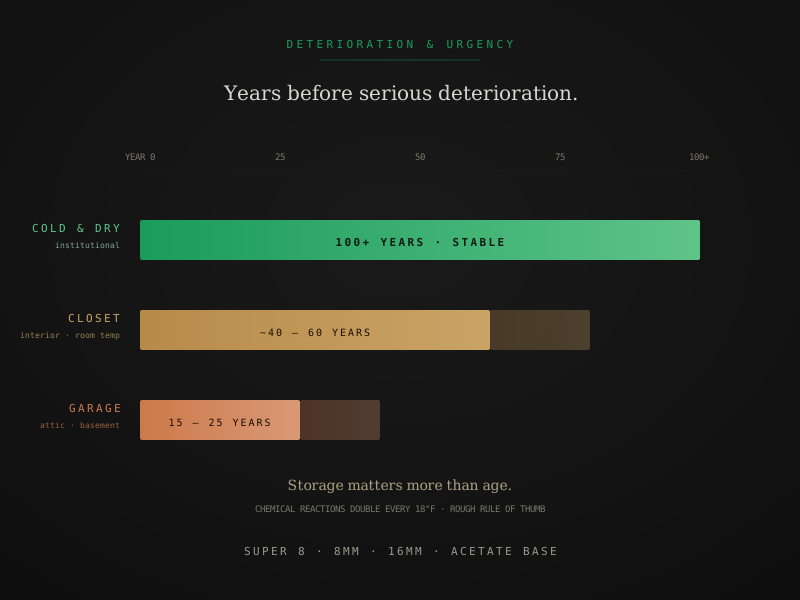
The honest answer to how long does film last is that storage conditions matter more than age. The same physical film, stored differently, can survive 100 years or fail at 25.
This is a realistic guide to film lifespan across home-movie formats — what affects the timeline, what different storage scenarios actually buy you, and what your film’s own age really means.
The framework
Film deterioration runs on chemistry, and chemistry runs on temperature and humidity. The relevant facts:
- Chemical reactions roughly double in rate for every 18°F of temperature increase
- High humidity (above ~60% RH) accelerates the chemistry further
- Cellulose acetate film (most stock from ~1948 to mid-1990s) breaks down via acetate hydrolysis, releasing acetic acid as a byproduct
- The reaction is autocatalytic — the acid produced accelerates further breakdown
- Polyester base film (post-1990s for most consumer stocks) is dimensionally stable and doesn’t undergo this process
The combination means storage history determines lifespan. Two identical 1972 Super 8 reels, one in an attic and one in a closet, have very different lifespans by 2026.
Three storage scenarios, mapped
What different conditions actually look like over time:
Climate-controlled archival storage
Conditions: 40°F, 30% RH. Sealed cans with desiccant. Stable year-round.
Realistic lifespan: 100+ years. Film at archival institutional storage shows minimal chemical change after 50 years and remains in good scannable condition past 100 years for cellulose acetate. Polyester-base film at the same conditions is essentially permanent on human timescales.
Where you find it: institutional preservation vaults. Library of Congress Packard Campus, the Academy Film Archive, university preservation libraries. Not practical for households.
Typical American home closet
Conditions: 65 to 75°F most of the year, 40 to 60% RH, indoor temperature swings of about 10 to 15 degrees seasonally.
Realistic lifespan: 40 to 60 years before clear signs of deterioration on cellulose acetate. Many film collections older than 50 years from this storage are showing early-stage vinegar syndrome by now — faint smell, mild color shift, no structural damage. Films younger than 40 years from this storage are typically fine.
Where you find it: the back of bedroom closets, hall shelves, under-bed storage, kitchen pantry. The dominant storage type for family collections in the United States.
Garage, attic, or damp basement
Conditions: 90°F+ in summer, often 30°F or below in winter, daily temperature swings of 30 degrees or more, humidity ranging from very low (winter heating) to very high (summer monsoons or basement damp).
Realistic lifespan: 15 to 25 years before serious deterioration. The chemistry runs roughly 3 to 5 times faster than interior storage. Reels stored in a 1985 garage typically show mid-stage vinegar syndrome by 2010 and severe damage by 2025.
Where you find it: the most common “forgotten” storage for film collections nobody actively manages. Often the storage discovered when the box is being moved out of a parent’s house after death or downsizing.
Format-specific considerations
Beyond storage, the film’s base material matters:
Cellulose triacetate base (~1948 — mid-1990s)
The dominant home-movie film base for the entire family-collection era. Susceptible to vinegar syndrome (acetate hydrolysis). Most Super 8, Standard 8mm, 16mm, and 35mm safety film from this period is acetate.
Lifespan in typical home storage: 40 to 60 years before clear deterioration. Lifespan in archival storage: 100+ years.
Cellulose nitrate base (pre-1952 35mm only)
35mm film made before 1952 may be cellulose nitrate, which is chemically unstable, highly flammable, and decays via a different and more dangerous process. Nitrate film requires specialist handling at nitrate-qualified institutions (Library of Congress Packard Campus, George Eastman Museum, UCLA Film & Television Archive). Don’t store, ship, or scan nitrate without specialist guidance.
Nitrate is rare in home collections but worth flagging for any pre-1952 35mm. For identification, how to identify your film format covers the safety-film vs nitrate test.
Polyester base (mid-1990s — present)
Modern professional and some consumer stocks use polyester base, which is dimensionally stable for centuries. Polyester film does not get vinegar syndrome. Image dyes can still fade and emulsions can still be physically damaged, but the base itself is essentially permanent.
For institutional projects shooting new film, polyester is the right base for any preservation-grade master. For family collections, polyester is rare unless someone shot recent stock.
Color vs black-and-white
Different chemistry, similar timeline:
Black-and-white film images last essentially as long as the base material does. Silver-halide images on stable base have been recovered from 100-year-old cellulose nitrate (the originals predating triacetate) when the base hasn’t failed. The image content itself is the most stable layer of the film.
Color film uses dyes that fade over decades regardless of base condition. Eastman Color stocks (the dominant Hollywood color film from the 1950s through 1980s) fade noticeably over 30 to 50 years even in good storage; in poor storage, color shift becomes severe within 20 years. Kodachrome — used in some Super 8 and 16mm consumer stock — fades much more slowly and is the most stable color film made.
Practical implication: if you have color reels showing pink or magenta tinting, the dyes have shifted but the image is still mostly recoverable through color correction during scanning. Severe fade may require restoration-grade work to recover original hues.
For deeper coverage of color fading specifically, the topic is well covered in film color fading when that post lands in M2.
What your film’s actual age means
For most American family collections, the math works out roughly like this:
- Pre-1965 — Standard 8mm or earlier formats. Now 60+ years old. Storage history is decisively important; many of these reels are showing some deterioration regardless of where they’ve been stored.
- 1965 to 1980 — Peak Super 8 era. Now 45 to 60 years old. At the threshold where typical home storage begins to show its effects. Smell test on a few representative reels is worth doing.
- 1980 to 1995 — Late Super 8 and early home video. Now 30 to 45 years old. Most still in good condition unless storage was poor.
- Post-1995 — Mostly home video by this point; little new film stock in family collections. If film exists, it’s often polyester base and stable.
The collection age tells you whether storage history matters yet. For pre-1980 reels, it usually does.
What “serious deterioration” actually means
When this guide says “serious deterioration by year 25,” the practical implications are:
- Stage 2 vinegar syndrome — clearly noticeable smell, mild warping, beginning color shift on color stocks
- Some brittleness at the splice points and edges
- Some emulsion lift in extreme cases
- Color shift of 10 to 30 percent on Eastman Color stocks
What it does NOT mean: the reels are unscannable. Stages 1 through 3 of vinegar syndrome are still fully recoverable through sprocketless scanning. The deterioration timeline matters because it determines when recovery becomes harder, not because it represents an absolute deadline.
For deeper coverage of vinegar syndrome stages and recoverability, vinegar syndrome — the complete guide walks the five-stage scale.
What you can do today
Three concrete actions, ranked by leverage:
1. Move out of bad storage
The single highest-leverage move. If your reels are currently in a garage, attic, or damp basement, the simple act of moving them indoors slows the chemistry by 3 to 5x. Costs nothing. Buys decades.
2. Separate affected reels
If the smell test reveals reels with vinegar syndrome, put them in their own container, separate from healthy reels. Acetic acid vapor accelerates decay in nearby clean film through air contact.
3. Plan for digitization within the relevant window
For healthy reels in good storage, no urgent timeline. Plan it when you can.
For mildly affected reels, plan within the next 12 months.
For seriously affected reels (strong smell, visible warping, brittleness), plan within 6 months and consider that some material may benefit from specialist intervention.
For the practical step-by-step on storage setup, how to store film reels is the longer companion piece. For the full deterioration framework with all the failure modes, film deterioration — what’s happening to your film right now is the umbrella reference.
The shortest version
If you remember three things:
- Storage matters more than age. Identical film in different conditions has different lifespans.
- Most American family collections are 40 to 60 years old now, which puts them right at the threshold where typical home-storage history begins to show.
- Recovery is still possible at most stages. The deterioration timeline matters because it shifts the difficulty of digitization, not because it represents an absolute end date.
The honest answer to how long does my film last? is: as long as its storage gives it, plus however long until you digitize it. Storage buys time. Digitization is what actually preserves the image content for the next century.
Quick answers from the bench
- Generally yes, but only because older film has had more time for its storage history to compound. Identical chemical processes affect new and old film at the same rates per year, but a 60-year-old reel has had 60 years of whatever conditions it was in, while a 20-year-old reel has had only 20. The age-versus-deterioration correlation is real but indirect — what's actually doing the work is cumulative storage exposure.