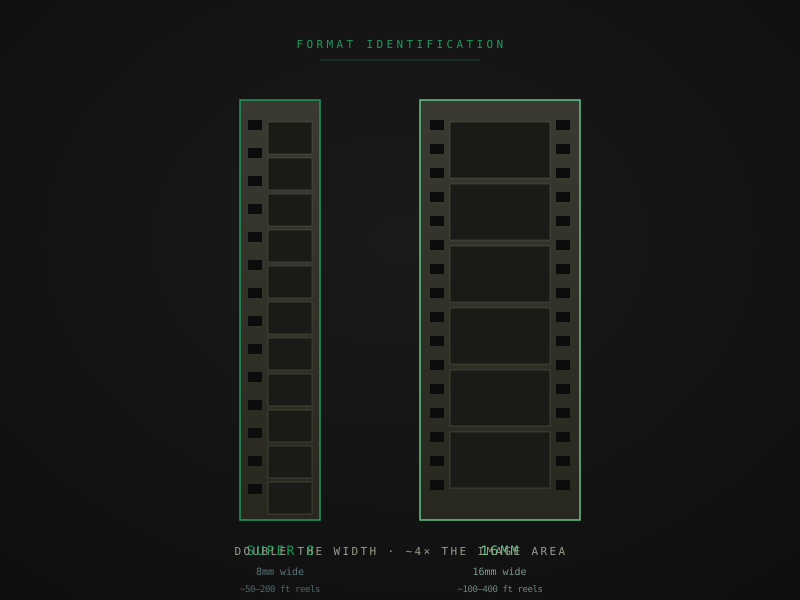
You found a box of film. Some of it’s small and feels light. Some of it’s noticeably bigger, in larger metal cans, and the film inside has visibly wider strips. You probably have two formats, and one of them is probably 16mm.
This is a guide to telling Super 8 from 16mm in under a minute, with the relevant differences for reel size, image quality, and what scanning each one actually means.
The one-sentence answer
Super 8 is 8mm wide. 16mm is 16mm wide. Lay them side by side and the difference is obvious before you reach for a ruler.
The visible test, in two checks
You don’t need a ruler if you can see both formats next to each other. Two checks confirm:
Check 1 — Compare widths
- Narrow film, fits comfortably across the tip of your thumb → Super 8 (8mm wide)
- Twice as wide, takes a full thumb-pad to span → 16mm (16mm wide)
If you only have one format in front of you and no reference, use a ruler. Lay a section of film against millimeter markings. 8mm and 16mm are unambiguous — there’s no format that’s 11mm or 13mm wide hiding somewhere in between.
Check 2 — Compare reel sizes
- Reel about the size of a coffee saucer (3–5 inches across) → Super 8
- Reel noticeably bigger, the size of a small dinner plate (5–7 inches across) → 16mm
Reel size scales with footage capacity. A 50 ft Super 8 reel is small enough to fit in a shirt pocket. A 400 ft 16mm reel is the diameter of a salad plate.
The reel test isn’t definitive on its own — some Super 8 reels run 200 ft and approach the size of small 16mm reels — but combined with the width check, you have your answer in seconds.
What 16mm actually is
16mm was introduced in 1923 by Eastman Kodak as an amateur and educational format. From day one it was sold in two configurations: silent 16mm with sprocket holes on both edges, and sound 16mm with sprockets on one edge and a soundtrack along the other.
Where Super 8 was Kodak’s answer to easy home-movie shooting (drop in a cartridge, shoot, send back for processing), 16mm was always a step up — bigger image, better quality, more expensive equipment, more deliberate intent. Documentary filmmakers, educational producers, news crews, and serious amateurs ran 16mm. Home-movie 16mm exists, but it tends to belong to families who treated filmmaking as more than a casual record.
The format had a long professional life. Through the 1970s and 1980s, network television news still shot 16mm in the field; documentaries shot 16mm long after Super 8 had faded from the home market. 16mm film stock is still manufactured today.
What Super 8 is, briefly
For the full Super 8 vs Standard 8mm story, the 8mm vs Super 8 guide covers it in detail. The short version:
Super 8 is the home-movie format Kodak introduced in 1965, designed around the cartridge camera. It’s 8mm wide, has rectangular sprocket holes on one edge only, and carries a noticeably larger image area than the older Standard 8mm format it replaced. Super 8 dominated American home moviemaking from the late 1960s through the early 1980s.
If your collection has small 8mm-wide reels, they’re almost certainly Super 8 (post-1965) or Standard 8mm (pre-1975). They are not the same as 16mm.
Why the size difference matters
16mm captures roughly four times the image area of Super 8 on the same exposure. The frame on a 16mm strip is about twice as tall and twice as wide as a Super 8 frame, which is the area math.
In a digital scan, that translates directly to detail. A 16mm reel scanned at 4K preserves more raw image information per square millimeter of original film than a Super 8 reel at the same resolution. The Super 8 scan can still look excellent — we’re talking about the comparison between two real archival captures, not between a scan and a transfer — but the 16mm version of the same scene at the same scanning resolution will be visibly sharper and less grainy.
Two practical implications:
- 16mm holds up better to upscaling and big-screen playback. A 16mm scan looks comfortable on a 65-inch TV; Super 8 looks watchable but visibly grainier at the same screen size.
- 16mm preserves more of the original camera operator’s framing decisions. Detail in faces, text, and shadow areas that’s lost in Super 8’s smaller frame is preserved in 16mm.
Practical reel-size and footage differences
Beyond image area, the formats differ in how much footage each reel holds and how fast they run:
| Super 8 | 16mm | |
|---|---|---|
| Film width | 8mm | 16mm |
| Frame rate (silent home movies) | 18 fps | 24 fps (typical) |
| Common reel sizes | 50 ft, 200 ft | 100 ft, 400 ft |
| Minutes per reel (silent) | ~3.5 min (50 ft) to ~14 min (200 ft) | ~3 min (100 ft) to ~11 min (400 ft) |
| Camera era | 1965 — present | 1923 — present |
The frame-rate difference matters during scanning. Both formats are scanned frame-by-frame at native rate, but 16mm at 24 fps means the scanner runs more frames per foot of film than Super 8 at 18 fps. The labor per minute of footage isn’t identical — though the per-foot pricing is, because labor is dominated by setup, inspection, and color work that doesn’t scale with frame rate.
Pricing at FPL
Both formats use the same per-foot scanning rate at FPL, because they’re both in the “small film” category and the same scanner handles both:
- Access: $0.42/ft (1080p H.264 deliverable)
- Preservation: $0.98/ft (4K capture, scene-by-scene color, ProRes 422 HQ master)
- Archival: $1.65/ft (4K capture, archival color pipeline, DPX or ProRes 4444 XQ; sound included)
Sound capture (rare on home-movie 16mm, common on professional 16mm) is +$0.12/ft on Access and Preservation tiers; included at Archival.
Where the per-reel cost diverges in practice: a Super 8 reel is typically 50 to 200 ft, so a single Preservation-tier scan runs $49 to $196 for the scanning portion. A 16mm reel is typically 100 to 400 ft, so the same Preservation-tier scan runs $98 to $392. Same per-foot rate, more film per reel.
For full per-tier pricing including handling, output media, and minimums:
- Super 8 service page
- 16mm service page
- Pricing page for the full rate card
The mixed-collection reality
Many institutional and family collections contain both formats. A documentary-minded grandparent shot 16mm in 1968. The same household shot Super 8 home movies in 1973 when the cartridge cameras got cheap. Both reels are sitting in the same closet box now.
This isn’t a problem. Pack the box, ship it, get one combined estimate. We sort by format at intake and label every reel by what it actually is.
If you want a more thorough pre-inventory before shipping, the format-identification guide walks through all four common formats (Super 8, Standard 8mm, 16mm, 35mm) in under five minutes per reel: How to identify your film format →
When to suspect you have 16mm
Some signals that point at 16mm without you having to measure:
- Cans noticeably larger than what you’d expect for “home movies”
- Heavier feel when you pick the box up
- Magnetic-stripe edge on the film (visible as a brown/rust stripe along one side)
- Optical-track edge on the film (visible as a printed waveform along one side)
- Documentary-style content visible on visible frames (you can see frames against light)
- Original packaging or labels that say “16” or reference Kodak’s 16mm product names
If you’ve got something that doesn’t look like the small Super 8 reels in the rest of the box, it’s probably 16mm. Treat it as a separate batch in your inventory and check the sprocket pattern (one edge = sound 16mm; both edges = silent 16mm) when you have a moment.
The shortest version
If you remember three things:
- Width tells you the format. Super 8 is 8mm; 16mm is 16mm. A ruler resolves it in seconds.
- Reel size scales with format. Super 8 reels fit in your hand; 16mm reels are noticeably bigger.
- 16mm captures more. ~4× the image area per frame, which translates to visibly more detail in a scan.
Both formats are scanned at the same per-foot rate at FPL. The right move when you have both is to pack them in the same box, ship together, and let intake sort the formats.
Quick answers from the bench
- The reel size is the immediate giveaway. Super 8 reels are typically 3 to 5 inches across; 16mm reels are 5 to 7 inches across. If the reel is bigger than the palm of your hand and feels heavy, it's 16mm. If the can is the size of a coffee saucer, it's Super 8. The width of the film itself confirms it — 16mm is exactly twice as wide as 8mm.