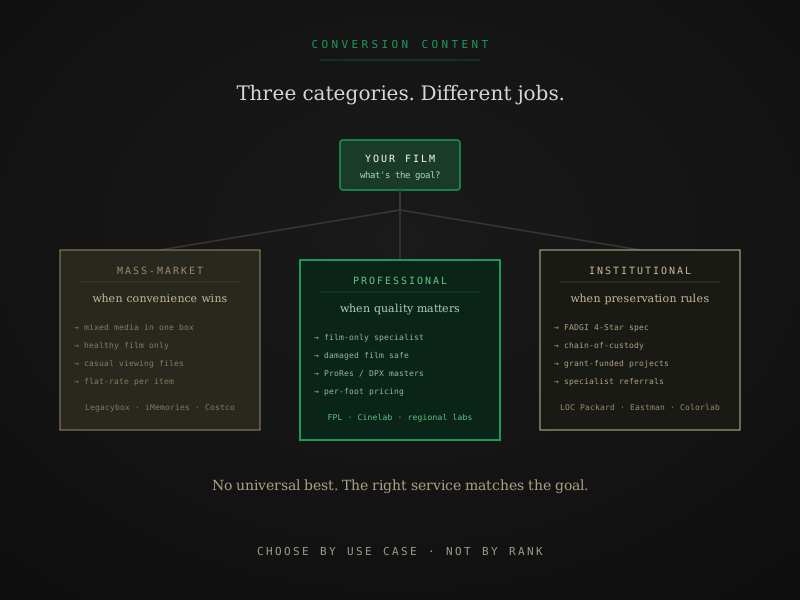
The phrase “best film digitization service” gets searched a lot. The honest answer is that there isn’t one.
What there is: three meaningfully different categories of service, each fit for a different kind of customer and project. The work of choosing isn’t finding the universal best — it’s figuring out which category your project actually belongs in, then evaluating vendors within that category against specific technical questions.
This guide is structured around that framework. It’s also written by FPL, which is itself a service on this list — in the professional consumer category. That bias is worth disclosing up front. The way this piece tries to address it is by being concrete about which category fits which need, including the cases where FPL specifically is the wrong choice.
The three categories
1. Mass-market consumer services
Examples: Legacybox, iMemories, ScanCafe, Costco/CVS partner programs, ScanMyPhotos.
Pricing model: Flat rate per item across mixed media (film, tape, photos, audio). Boxes of varying capacity. Typical project total: $75 to $400+ depending on box size.
What they do well:
- One shipment for mixed-media collections
- Predictable per-item pricing
- Fast turnaround on tape and photo
- Genuinely competent at video tape and photo scanning
What they do less well:
- Film capture is typically projector-based transfer, which loses 40 to 60 percent of the image information versus frame-by-frame scanning
- Damaged-film handling is limited (mass-market services often refuse film with vinegar syndrome or visible deterioration)
- Output is sized for casual viewing, not editorial or archival use
- Turnaround on film specifically often runs 6 to 12 weeks
Right fit for: healthy mixed-media collections digitized for one-time casual viewing, where convenience matters more than archival quality on the film specifically.
For deeper coverage of how mass-market services handle film specifically, Legacybox vs professional film scanning and iMemories vs archival film scanning walk those comparisons in detail.
2. Professional consumer film labs
Examples: Film Preservation Lab (FPL), Cinelab, Pro8mm, Spectra, Modern VideoFilm, regional labs like Color Lab in Maryland or Cinema Cleveland.
Pricing model: Per foot of film, with separate tiers for capture quality and output format. Per-format handling fees on top. Typical project total: $200 to $2,000+ for a typical home-movie collection.
What they do well:
- Frame-by-frame scanning from calibrated digital scanners
- Sprocketless transport for damaged film handling
- Master-grade output formats (ProRes, DPX) at higher tiers
- Scene-by-scene color correction at Preservation tier and above
- Per-reel quality control and inspection
- Documented chain of custody
What they do less well:
- Most professional film labs are film-only and don’t handle tape or photo
- Pricing is harder to predict than mass-market until intake measurement
- Turnaround is typically 3 to 5 weeks, sometimes longer for institutional or complex projects
Right fit for: film-only projects (or the film portion of mixed collections) requiring archival quality, damaged-film handling, or editorial-grade output. Family archives intended to outlast the original owner. Small-to-mid-sized institutional collections.
This is the category FPL operates in. We mention specific competitors (Cinelab, Pro8mm, Spectra) without ranking them — for any specific project, you should evaluate vendors in this category against the 10-question checklist below, on equal terms.
3. Archival institutional facilities
Examples: Library of Congress Packard Campus, George Eastman Museum, UCLA Film & Television Archive, Academy Film Archive, Colorlab, Cinelab’s preservation wing, FotoKem, dedicated restoration houses.
Pricing model: Project-based custom quotes. Typical project total: thousands to millions of dollars depending on scope.
What they do well:
- The strictest preservation specifications in the field (FADGI-informed and beyond)
- Nitrate film handling (where qualified)
- Severe-deterioration recovery (wet-gate scanning, solvent rehydration, manual frame restoration)
- Grant-application support and institutional partnerships
- Color-restoration grading at the highest available level
What they do less well:
- Not designed for consumer projects — minimum project sizes typically exclude single-family collections
- Long lead times for project intake
- Pricing isn’t consumer-accessible
Right fit for: institutional preservation projects with grant funding, nitrate film, severely deteriorated material requiring specialist intervention, color-sensitive cinema preservation. The customers in this category are typically institutional collection managers, grant administrators, and archivists working on grant-funded projects.
For most institutional film projects below the highest restoration tier, professional consumer film labs (category 2) plus FADGI documentation are the right fit. For deeper coverage, FADGI compliance for film digitization walks the institutional buyer’s framework.
The 10-question vendor checklist
Use this list on any vendor in any category. Honest, specific answers filter out most of what matters regardless of which category you’re shopping in.
-
What scanner or transfer equipment do you use? Real frame-by-frame scanners have a make and model (Lasergraphics ScanStation, Filmfabriek HDS+, BlackMagic Cintel, MWA Flashscan Nova, Sondor). Mass-market services typically describe a projector-based setup. The clarity of the answer is itself the answer.
-
What is the native capture resolution off the film? Should be specific (2K, 4K, 6K) and refer to what the scanner sensor reads off the film, not what the output file encodes to.
-
Is the transport sprocketless? Yes-or-no question. Sprocketless transport is the modern standard for any service handling older or potentially damaged film. For deeper coverage, sprocketless film transport walks the engineering.
-
What output formats do I receive at each tier? Real archival labs deliver master files (ProRes, DPX) plus access copies. Mass-market services typically deliver one MP4. The number and type of deliverables tells you whether the service is built for casual viewing or long-term preservation.
-
What is your damaged-film policy? A vendor who refuses damaged film, or who scans it on equipment that may damage it further, isn’t the right answer for older collections. Sprocketless transport handles brittle, shrunken, and vinegar-affected film safely.
-
Do you quote surcharges before scanning, and is there a customer-approval window? Hidden charges discovered at final invoice time are a red flag. A legitimate vendor sends a condition report after intake, quotes any surcharges, and waits for explicit approval before chargeable work begins.
-
How are originals returned, and what insurance applies? Customer-billed return shipping is normal; what matters is whether the originals are returned at all (some discount services keep them) and whether they ship insured and tracked.
-
What is your chain of custody documentation? Especially relevant for institutional or rare collections. A vendor who can produce intake-to-delivery documentation has a process; a vendor who can’t doesn’t.
-
How are files delivered, and what happens to them after the project? Cloud download links, USB drives, or institutional file transfer should all be specified. Some services delete files after a retention period; some retain indefinitely. Both can be legitimate — you just want to know which.
-
What is the realistic turnaround? Mass-market services often advertise fast turnaround that doesn’t materialize during peak season. Professional labs typically run 3 to 5 weeks. Either way, ask for a realistic estimate including peak-season delays.
For deeper coverage of each question and what good answers actually look like, 10 questions to ask before choosing a film digitization service is the longer companion piece.
A practical decision flow
Three questions that resolve which category fits your project:
Question 1: What media do you have?
- Film only → professional consumer or institutional, depending on scope
- Mostly tape and photos, some film → mass-market for the bulk, optionally splitting film to a professional lab
- Mostly film, some tape and photos → split the work; professional film lab for film, mass-market for the rest
Question 2: What is the film’s condition?
- All healthy, no smell, no warping → either mass-market (casual viewing) or professional consumer (archival quality), depending on goal
- Some deterioration (vinegar smell on a few reels, mild brittleness) → professional consumer is the right answer for at least the affected reels
- Severe deterioration (strong vinegar smell, crystals, fused reels) → institutional facility or specialist referral; some professional labs (including FPL) refer these out
Question 3: What will you do with the file?
- Watch once with family, never edit → mass-market is fine for healthy film
- Build a family archive that may be revisited or shared with future generations → professional consumer
- Edit, restore, color-correct, or use editorially → professional consumer minimum, possibly institutional for restoration work
- Grant-funded institutional preservation → institutional or professional consumer with FADGI documentation
When in doubt: the hybrid pattern
For most mixed-condition family collections, the practical answer isn’t a single service — it’s a split:
- Healthy film with casual-viewing intent → mass-market or DIY
- Affected film or archival-intent film → professional consumer
- Tape and photos → mass-market
This pattern usually keeps total spend lower than scanning everything at archival rates and produces a meaningfully better final archive than scanning everything at mass-market rates.
What this guide deliberately doesn’t do
A few omissions worth flagging:
- No specific competitor pricing. Pricing across categories changes faster than blog posts update. The framing here is about category fit, not specific dollar comparisons.
- No specific competitor service-quality claims beyond what’s broadly known. Quality varies within each category and between operators at the same vendor.
- No ranking within categories. I’m not in a position to objectively rank FPL against Cinelab or Pro8mm or any other specific competitor — and any “best of” ranking that includes the publisher inevitably has a thumb on the scale.
What you should do next
If you’ve identified the right category for your project:
- Mass-market: visit Legacybox, iMemories, or your local big-box partner. Compare flat-rate pricing for your collection size.
- Professional consumer: send inquiries to two or three labs in this category, including FPL. Use the 10-question checklist on each. Compare answers.
- Institutional: contact your nearest FADGI-aligned institutional facility or grant-funded preservation partner. Most won’t take consumer-scale projects but will refer you to the right professional consumer lab.
For FPL specifically, the /start page produces a structured estimate in under two minutes — useful for comparing against other professional consumer quotes. The estimate is free, no card up front, no commitment.
The shortest version
If you remember three things:
- There is no universal best. Right service depends on collection, condition, and goal.
- Three meaningful categories: mass-market for convenience, professional consumer for archival quality, institutional for grant-funded preservation.
- Use the 10-question checklist on every vendor you consider. Specific honest answers filter out most of what matters regardless of category.
The goal of this piece isn’t to convince you FPL is the answer. It’s to give you a framework that surfaces the right answer for your project, even when that answer is somewhere else.
Quick answers from the bench
- You probably should not trust any "best of" guide as the final word, including this one. What you can do with this guide — or any review you find online — is use it as a starting framework, then verify the specific claims against the vendors directly with concrete technical questions. The 10-question checklist below is the same set of questions we recommend using on FPL, on every other service mentioned, and on any film digitization vendor you are considering. The right vendor for your project answers all 10 honestly and specifically.